How Kiln Thinks About The Revenue Engine Of A Coworking Business
Revenue in coworking is not only a sales function. It is shaped by the product mix, market positioning, pricing, lead response, member experience, community activity, retention, referrals, events, and how clearly the team can see what is happening across the business.
TL;DR
- Kiln treats revenue as a whole-business discipline. Sales matter, but product mix, pricing, retention, community, events, referrals, and technology all influence performance.
- Revenue occupancy gives a better view than physical fullness alone. A space can feel busy and still underperform if the wrong products are sold or revenue per available space is too low.
- Product mix is one of the hardest decisions to fix later. Private offices, suites, desks, meeting rooms, phone booths, and shared areas need to reflect local market demand before opening.
- Pricing has to be local and evidence-based. Kiln uses market research, competitor positioning, office benchmarks, demand signals, and member response to evaluate pricing.
- Technology supports visibility, but teams need training and integration. HubSpot, OfficeRnD, Gemini, CRM AI, and better data flows help only when teams know how to use them.
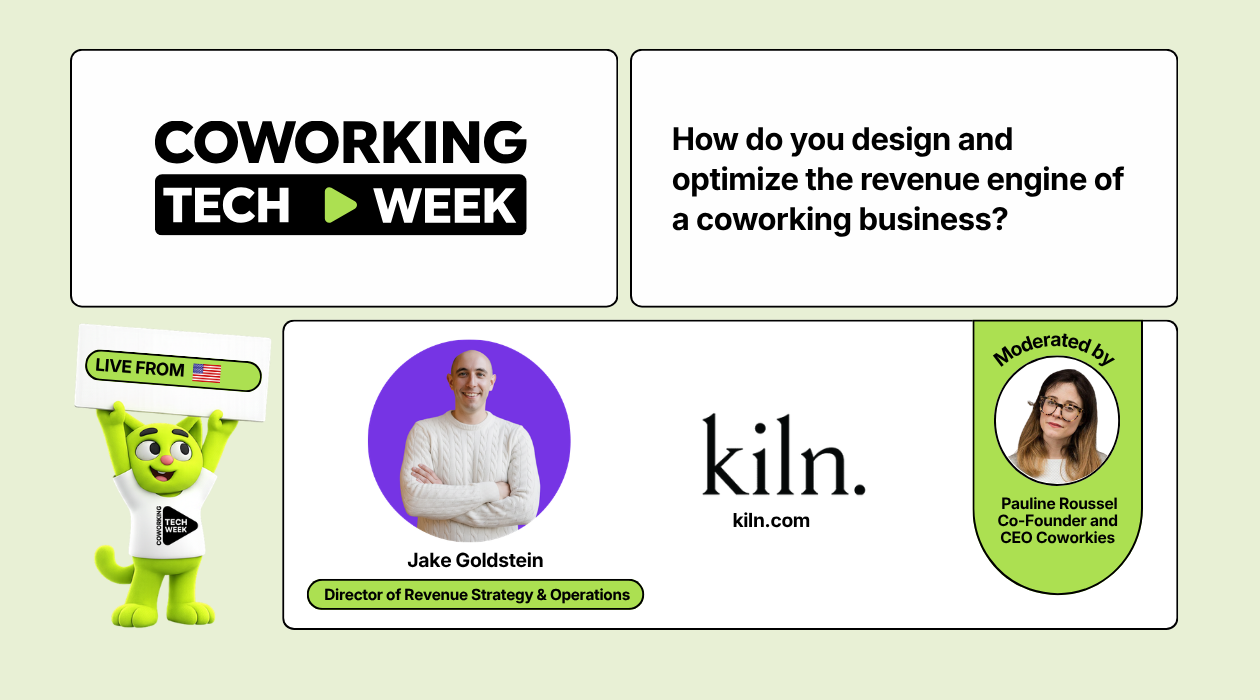
This article is based on the Coworking Tech Week replay, How do you design and optimize the revenue engine of a coworking business?, featuring Jake Goldstein, Director of Revenue Strategy and Operations at Kiln. The replay is a practical discussion for operators thinking about revenue occupancy, product mix, pricing, CRM workflows, OfficeRnD, HubSpot, AI, retention, and growth across multiple locations.
Revenue is built across the business
Jake’s central point is that a coworking revenue engine is not just sales.
Sales converts leads, but the wider business creates the conditions for those sales to happen. Marketing creates awareness. Community teams support retention and referrals. Growth teams study market fit and product mix. Events bring people into the building. Technology helps the team see patterns early enough to act.
That makes revenue strategy a cross-functional operating system. A location can have a strong sales team and still underperform if product mix is wrong, pricing is weak, member experience is inconsistent, or retention signals are missed.
Why revenue occupancy matters
Kiln looks closely at revenue occupancy when evaluating location performance. This is different from asking whether a space feels physically full.
A building can look active and still generate less recurring revenue than it should. The issue may be pricing, product mix, too much low-yield inventory, underperforming meeting rooms, weak upsell paths, or products that do not match local demand.
Revenue occupancy helps the team understand whether a location is producing the revenue expected from the available space. It also changes priorities. A ramping location may need more lead generation and market visibility. A strong location may need more attention on retention, member experience, referrals, and protecting the community that drives future sales.
Product mix before pricing
One of the most practical ideas in the Kiln replay is that product mix is harder to fix than pricing.
Prices can be adjusted. The physical layout of a space is much harder to change after opening. The mix of private offices, team suites, reserved desks, meeting rooms, phone booths, shared areas, and event spaces has to reflect local demand from the start.
Kiln does not assume every market needs the same mix. A city with demand for small offices may need a different layout than a market where larger team suites perform better. Lessons from existing locations can shape future openings. If one location sells out of two-person offices quickly, that insight belongs in the next planning conversation.
This is where revenue strategy connects directly to real estate and design. A high-performing coworking space is not only well sold. It is configured for the market it serves.
Pricing is local
Kiln approaches pricing market by market. Jake describes using local demand, competitor positioning, traditional office benchmarks, and market reports from firms such as JLL, CBRE, and Cushman & Wakefield.
The goal is not to copy a standard rate card across locations. It is to understand where each Kiln space sits relative to the local office market and other flexible workspace options.
Pricing should also be tested against real demand signals. Is the location meeting revenue goals? Are certain products waitlisted? Do members accept annual increases? Is resistance a pricing problem, a communication problem, a service problem, or a product problem?
Those questions make pricing more evidence-based and less reactive.
Technology behind revenue decisions
Kiln uses HubSpot as its CRM and OfficeRnD for member management. Those tools support lead tracking, renewals, memberships, and member data.
Jake points to an ongoing opportunity: connecting systems more clearly. Renewal data may sit in HubSpot while product and membership data sit in OfficeRnD. To understand performance, teams need information from both places to work together.
Kiln also uses Gemini, and Jake mentions AI features inside HubSpot such as Breeze AI. The value of AI is not replacing judgment. It is helping teams summarize information, identify patterns, and see whether a cancellation, complaint, traffic change, renewal issue, or event result is a one-off or part of a larger trend.
As brands grow across locations, that pattern recognition becomes more valuable because leaders cannot rely only on anecdotal updates.
Dynamic pricing needs operational readiness
Kiln has explored dynamic pricing for products such as meeting rooms, conference rooms, day passes, and other demand-sensitive offerings.
Jake is careful about the lesson. A previous attempt at dynamic pricing for meeting rooms did not perform as expected. The issue was not only the pricing model. The team also needed better tools, clearer internal processes, and stronger language to explain price changes to leads and members.
That is a useful warning. Pricing changes do not happen only in a spreadsheet. They happen in sales conversations, member expectations, front desk explanations, booking flows, and renewal discussions. If the team cannot explain the change, trust can suffer.
Dynamic pricing is not only a revenue idea. It is an operations and communication project.
What operators should review monthly
We would turn the Kiln session into a monthly revenue review checklist:
- Revenue occupancy by location and product type.
- Lead volume, lead source, response time, and conversion path.
- Product mix performance: offices, suites, desks, meeting rooms, events, and memberships.
- Pricing position against local competitors and office benchmarks.
- Waitlists, underused inventory, and products with repeated demand.
- Meeting room and event revenue trends.
- Member feedback, renewal risk, expansion signals, and churn reasons.
- Referral activity and community-driven demand.
- CRM and member management data gaps.
- Market signals such as seasonality, local events, website traffic, inbound demand, and campaign performance.
The wider lesson is that coworking revenue improves when operators see the business early enough to act. Pricing, product mix, sales, retention, and member experience all shape the engine. Technology helps when it gives the team clearer visibility and better timing.
Watch the full Coworking Tech Week replay with Jake Goldstein for the complete Kiln discussion on revenue occupancy, product mix, local pricing, OfficeRnD, HubSpot, AI, demand signals, retention, and partnerships.

Written by
Dimitar InchevCo-Founder & CTO at Coworkies
Dimitar Inchev is Co-Founder and CTO at Coworkies, writing about coworking technology, operations, community building, and workspace growth.