The Invisible Operating System Behind A Great Coworking Space
Members rarely notice a coworking space’s operating system when it works. They notice when the door is confusing, the Wi-Fi fails, the room setup is wrong, the microphone feeds back, the app feels like an extra burden, or nobody knows how to fix the temperature. The best operations often feel invisible because the member can simply use the space.
TL;DR
- Great coworking experiences depend on invisible operational design. Members feel the result of access, Wi-Fi, onboarding, AV, event workflows, room setup, and team training even when they do not see the systems.
- Den 1880 treats coworking as hospitality. Comfort, atmosphere, lighting, sound, temperature, scent, service, and welcome all influence whether people choose the space over working from home.
- The tech stack supports several business lines. Den uses tools for member management, access control, Wi-Fi check-ins, events, marketing, communication, and daily operations.
- Technology can also create friction. App adoption, access control gaps, check-ins, AV issues, and disconnected systems can make a complex space harder to run.
- Small details matter. Coffee machines, microwaves, desk drawers, TVs, temperature controls, and room setup become part of the member experience.
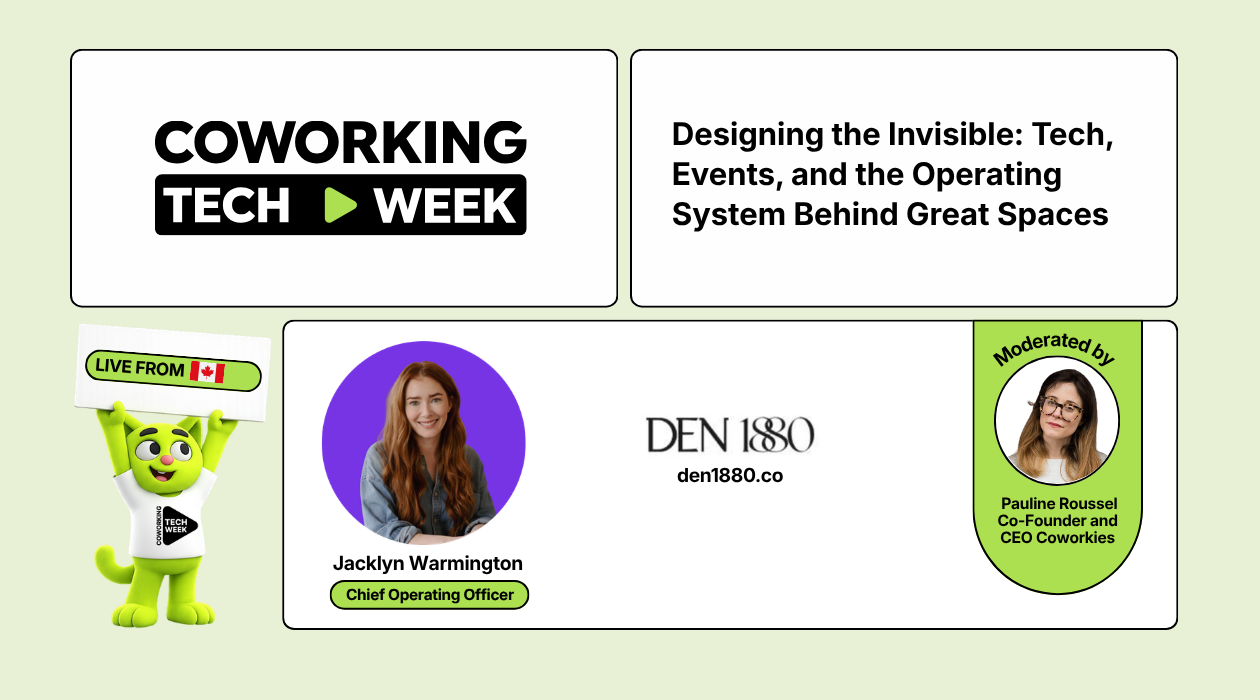
This article is based on the Coworking Tech Week replay, Designing the Invisible: Tech, Events, and the Operating System Behind Great Spaces, featuring Jacklyn Warmington, Chief Operating Officer at Den 1880 in Waterloo, Canada. The replay is a practical look at how technology supports hospitality, events, onboarding, and member experience inside a complex coworking space.
Members notice friction
Coworking operators often talk about technology in terms of systems: member management, access control, Wi-Fi, CRM, booking tools, event software, email platforms, and AV setups. Members experience those same systems as moments.
Can they enter the building? Can they find the room? Does the Wi-Fi work? Are check-in instructions clear? Does the screen connect? Does the microphone work? Can they get help quickly? Does the space feel comfortable enough to stay?
That is why the Den 1880 session is useful. It shows that the technology behind a coworking space is not separate from hospitality. It is one of the ways hospitality becomes reliable.
Inside Den 1880's hospitality model
Den 1880 is a coworking space, event venue, private office space, gym, and wellness facility in Waterloo, Canada. It sits inside a restored historic building from 1880, which gives the space character and complexity at the same time.
Jacklyn frames coworking as a hospitality-driven business. Members often have the option to work from home, so the space has to give them a reason to come in. That reason includes desks and Wi-Fi, but it also includes atmosphere, comfort, lighting, sound, temperature, scent, service, and welcome.
In a historic building, the operating layer becomes even more important. Access, temperature, acoustics, room flow, events, member movement, and building quirks all require attention. A beautiful space still needs to function.
The stack behind the member journey
Den 1880 uses several tools across its business. Optix supports coworking management, member communication, CRM, lead tracking, bookings, automations, onboarding, and check-ins. Brivo handles building access control. IronWiFi supports Wi-Fi-based check-ins and tracking, which matters because many members enter through the back of the building rather than the main entrance.
Events run through a different operational pattern. HoneyBook helps with event communication, contracts, invoices, and follow-up, keeping details organized when email threads could otherwise become difficult to manage. The team also uses tools such as Mailchimp, social media, video content, smart TVs, and plug-and-play meeting room technology.
The important lesson is that a complex space rarely has one system behind it. The operator’s job is to make several systems feel like one coherent journey for members, guests, event hosts, and the internal team.
Where technology creates friction
Technology supports the experience, but it can also get in the way.
App adoption is one example. From the operator’s side, an app can support check-ins, communication, and member follow-up. From the member’s side, it can feel like one more thing to download and remember.
Access control and check-ins are another example. Jacklyn reflects that if Den were redesigning the setup, she would want access, check-ins, and member management to work more smoothly together from the beginning. Switching platforms or reworking integrations after a space is operating is a major undertaking.
Event technology adds its own pressure. Microphones, sound feedback, speaker placement, acoustic panels, screen connections, and room layout all need to be tested before guests notice a problem. An event room changes once people fill it, which means AV and operations need to be prepared for the real use case, not only the empty-room setup.
Community is not only digital
Den experimented with digital community tools, including a discussion board, but members did not engage heavily with it. The team now focuses more on in-person introductions, monthly happy hours, name tags, direct invitations, and low-pressure opportunities for people to meet.
That is a useful reminder for operators building a coworking tech stack. Community tools can support connection, but they do not replace hosting. Someone still needs to notice who should meet, create the context, invite people in, and make the first interaction easier.
Digital systems can help with communication and follow-up. The relationship work still happens between people.
Training a small team for a complex space
Running Den 1880 requires the team to understand both software and the building itself.
New team members learn through shadowing, hands-on practice, documentation, and a detailed onboarding manual. That documentation covers recurring processes and small technical issues, but some knowledge is learned only when real issues happen: a room setup fails, a member cannot access something, the AV behaves differently during an event, or the building creates a new edge case.
This is why training is part of the operating system. A complex coworking space needs people who can connect the system, the member, the room, and the moment.
The small details members remember
One of the strongest parts of the session is Jacklyn’s attention to everyday details: coffee machines, microwaves, dishwashers, fingerprint-locked drawers, desk setup, TVs, temperature controls, room controls, and the small fixes that keep a space feeling cared for.
These may not sound strategic, but they are part of the member experience. When they work, members do not think about them. When they fail, they become the thing people remember.
The broader lesson is that hospitality in coworking is operational. It lives in tools, training, setup, documentation, maintenance, events, communication, and human attention. Technology should reduce friction enough that the member can feel the space, not the system.
Watch the full Coworking Tech Week replay with Jacklyn Warmington for the complete Den 1880 discussion on access, Wi-Fi, onboarding, events, AV, team training, and the invisible operating system behind a great coworking space.

Written by
Dimitar InchevCo-Founder & CTO at Coworkies
Dimitar Inchev is Co-Founder and CTO at Coworkies, writing about coworking technology, operations, community building, and workspace growth.