Data Is Useful When It Changes How A Flex Workspace Is Run
Most flex workspace operators already have more data than they use. Wi-Fi, access control, CRM activity, member feedback, meeting room bookings, sensors, and building systems are already producing signals. The harder question is not how to collect more data. It is which decisions the data should improve.
TL;DR
- Data becomes useful when it changes a decision. Occupancy, renewal risk, meeting room demand, energy use, cleaning, and member experience should connect to action, not just reporting.
- Operators already have many data sources. CRM, Wi-Fi, access control, door entry, building systems, environmental sensors, bookings, and feedback can all show how a workspace is being used.
- Occupancy data can support revenue and retention. Underuse can signal churn risk; consistent fullness can signal expansion opportunity.
- Building performance is a major data opportunity. HVAC, lighting, cleaning, facilities management, and sustainability decisions can improve when operators understand real usage patterns.
- Dashboards are not enough. Teams need data skills, context, privacy discipline, and human feedback to interpret patterns properly.
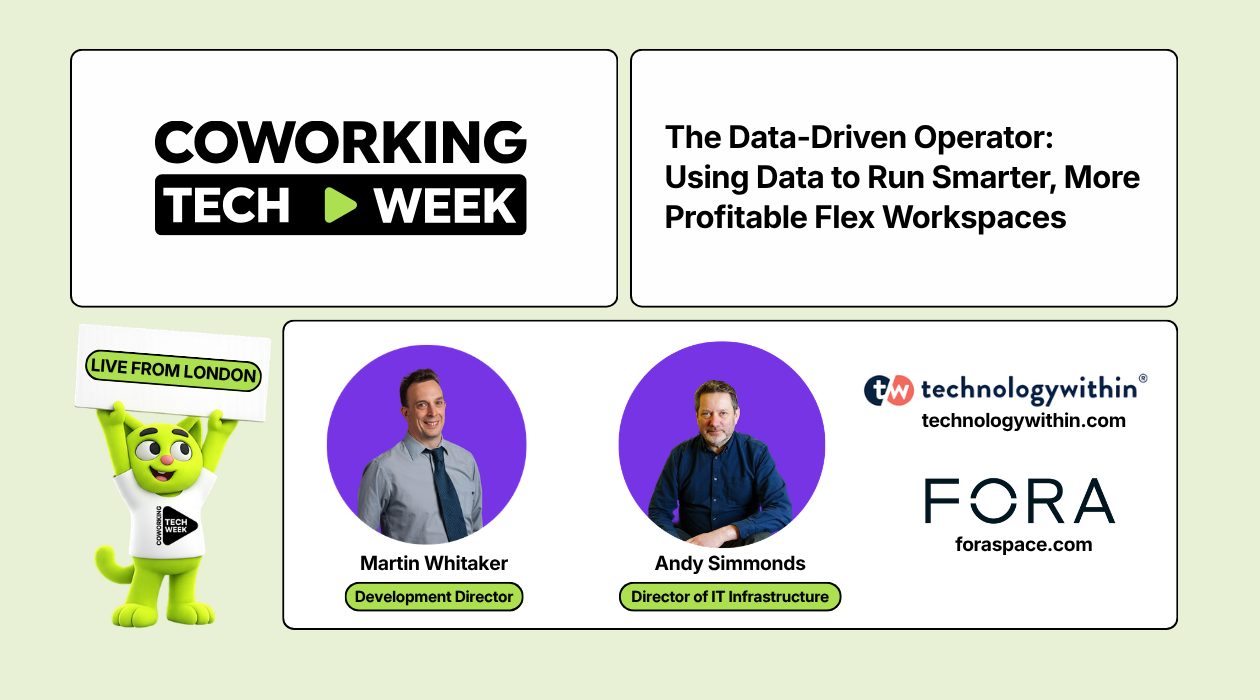
This article is based on the Coworking Tech Week replay, The Data-Driven Operator: Using Data to Run Smarter, More Profitable Flex Workspaces, featuring Martin Whitaker, Development Director at technologywithin, and Andy Simmonds, Director of IT Infrastructure at The Office Group. The session connects workspace data to practical decisions across revenue, retention, building efficiency, member experience, and portfolio operations.
Start with the decisions
The weakest version of a data project starts with dashboards. The strongest version starts with decisions.
What do we need to know before a renewal conversation? Which rooms are underused? Which buildings are busiest on which days? Where is energy being wasted? Which members may not be getting full value from the space? Which service problems are members feeling before they submit a ticket?
Martin and Andy keep the session grounded in those questions. The goal is not to make flex workspace operations look more technical. The goal is to help operators run better buildings, support members earlier, reduce waste, and make investment decisions with more confidence.
The data operators already have
Martin’s first useful point is that operators often already have valuable data inside existing systems.
CRM platforms show sales activity, account history, renewals, and customer relationships. Wi-Fi can suggest how people move through and use a building. Access control and door entry show entry patterns. Booking systems show intended room and resource use. Environmental sensors and building systems can show temperature, air quality, energy use, and comfort. Member feedback adds the human layer.
This is why data belongs inside the wider future of coworking technology conversation. Operators do not always need a completely new platform to begin. They need to understand what they already have, what is reliable, and what business question each data source can help answer.
Occupancy can support revenue and retention
Occupancy data can support both commercial and member experience decisions.
If a company rents a 12-person office but only a few people appear to be using it regularly, that may be a signal for the account team to check in before renewal. The right response might be a smaller office, a different product, a better onboarding conversation, or support with getting more value from the space.
If a company’s space is consistently full, the same data may point toward expansion. The operator can have a more timely conversation about more desks, a larger office, meeting room needs, or another location.
The point is not to monitor individuals. It is to use aggregate patterns to support better account management, retention, and revenue conversations.
Space planning and meeting room decisions
Data can also show which parts of a building are working and which need attention.
If certain rooms or floors are consistently busy, the operator can investigate why. Is it layout, daylight, proximity to amenities, acoustics, team preference, or product fit? If other areas are consistently underused, the operator can review design, pricing, programming, or repositioning.
Meeting room data is especially useful because it connects member experience and revenue. If demand is high, operators may adjust room mix, pricing, availability, or booking rules. If demand is weak, the question may be whether the room is the wrong size, poorly equipped, hard to find, or not marketed clearly.
This is where workspace data becomes practical: it helps operators see whether the physical product matches real behavior.
Building performance and sustainability
The session also makes a strong case for using data beyond sales and occupancy.
Occupancy and environmental data can support decisions around HVAC, lighting, cleaning, facilities management, and energy efficiency. If a floor is consistently quiet on Fridays, the operator may be able to adjust HVAC output or cleaning schedules. If certain areas are busy at specific times, staffing and facilities planning can respond.
These decisions affect operating cost and sustainability. They also affect comfort. A building that responds more intelligently to real use can be cheaper to run and better to work in.
For a portfolio operator such as Fora / The Office Group, the scale makes this especially important. Andy describes a large portfolio where better visibility supports design, IT, facilities, operations, and leadership decisions across many buildings and thousands of members.
Privacy, patterns, and interpretation
Data needs interpretation. Wi-Fi can indicate activity, but one person may carry multiple devices. Some devices may not connect. Privacy features can affect accuracy. Access control can show swipes, but it does not always map neatly to how long someone used a space or why they moved.
Andy is clear that operators should focus on aggregate patterns rather than trying to track individuals. That matters for privacy, GDPR, member trust, and practical accuracy.
The session also makes the case for data skills. Dashboards alone do not create insight. Teams need to understand where the data comes from, how reliable it is, what it can show, what it cannot show, and how to combine it with human feedback from the floor.
That last point is important. Members may experience Wi-Fi, room, comfort, or service issues without submitting a formal ticket. The best operators combine data with what staff hear directly in the building.
Where smaller operators should start
Smaller operators do not need to begin with a major smart building project. Andy’s advice is to stay focused on clear business questions.
We would start with:
- Which spaces are busiest and quietest by day and time?
- Which members appear to be underusing what they pay for?
- Which members may be ready to expand?
- Which rooms or resources create the most friction?
- Where are meeting rooms underpriced, overbooked, or underused?
- Which building costs could be adjusted based on real occupancy?
- What feedback are members giving informally that dashboards miss?
Once those questions are clear, operators can decide which data sources matter and where a technology partner should be involved. Martin’s point about involving partners earlier in building or fit-out planning is practical: infrastructure decisions made early can determine what data will be available later.
AI may eventually help operators connect multiple data sources, spot patterns, and support forecasting. But the foundation is still reliable data, clear questions, and people who know how to interpret what they see.
Watch the full Coworking Tech Week replay with technologywithin and The Office Group for the complete discussion on occupancy data, Wi-Fi, access control, CRM, feedback, building systems, privacy, member experience, and portfolio operations.

Written by
Dimitar InchevCo-Founder & CTO at Coworkies
Dimitar Inchev is Co-Founder and CTO at Coworkies, writing about coworking technology, operations, community building, and workspace growth.