Coworking Discovery Is Local: What Operators Can Learn From UK, Dubai And Netherlands Demand
Coworking discovery is no longer one simple journey. A potential customer may come from Google, WhatsApp, Instagram, a broker, a marketplace app, a referral, an hourly booking, a corporate pilot, or a community partnership. The right sales strategy depends on the market.
TL;DR
- Coworking discovery differs by market. The UK, Dubai, the Netherlands, and broker-led office search all show different customer behaviors and conversion paths.
- Hourly access can create new demand. In the UK, Werksy sees users coming from cafes, libraries, homes, community spaces, and other informal work settings, not only from other coworking spaces.
- Dubai discovery is highly digital and referral-led. WhatsApp, social media, personal recommendations, and viral visibility matter because the city is car-based and climate shapes movement.
- Many customers start with practical criteria before brand preference. Location, price, availability, amenities, desk size, photos, and fit can matter before a user develops loyalty to a specific space.
- Marketplaces can help or hurt depending on fit. Operators need to consider curation, listing quality, pricing pressure, brand context, and lead follow-up before choosing channels.
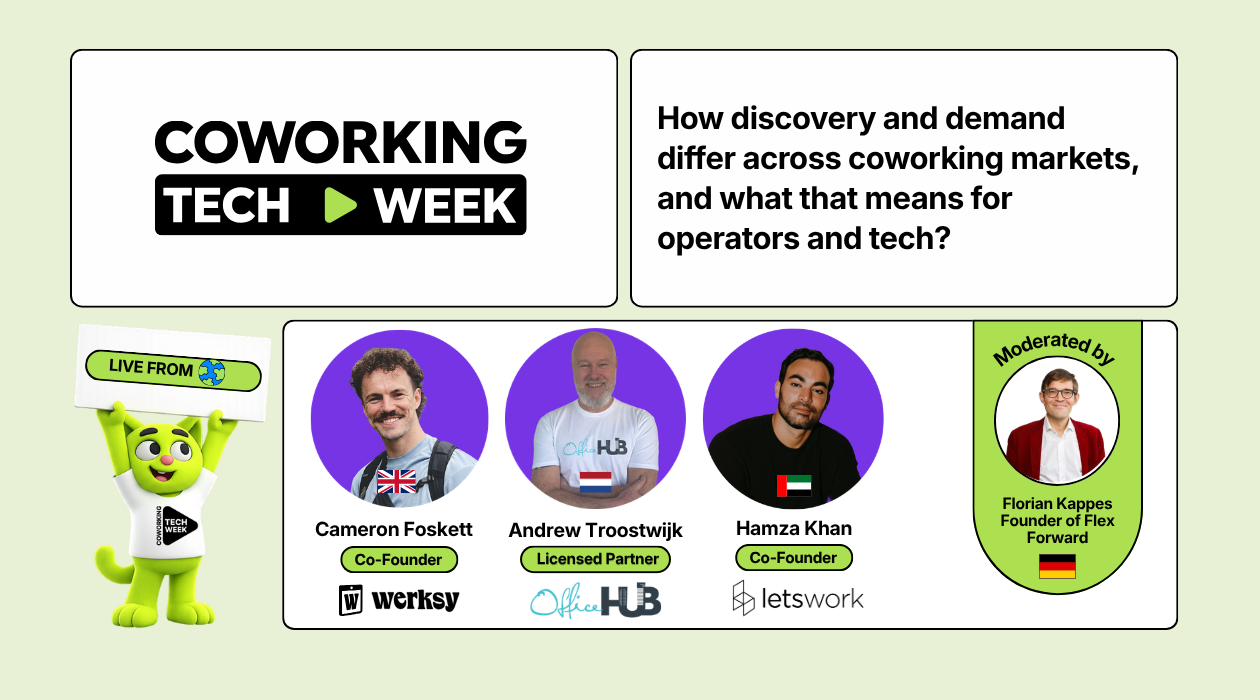
This article is based on the Coworking Tech Week replay, How discovery and demand differ across coworking markets, moderated by Florian Kappes with Hamza Khan from Letswork, Cameron Foskett from Werksy, and Andrew Troostwijk from Office Hub. The panel is useful for operators choosing between marketplaces, brokers, referrals, paid channels, hourly products, and direct sales.
Discovery is no longer one journey
The main lesson from the panel is that coworking discovery depends heavily on local behavior.
In some markets, users search directly. In others, they rely on WhatsApp, social media, referrals, brokers, or marketplace apps. Some people are not actively looking for coworking at all. They are working from cafes, homes, libraries, or informal community spaces until a lower-friction offer gives them a reason to try a space.
That means operators should not copy one demand strategy across locations. A coworking tech stack can support visibility, booking, availability, and follow-up, but it still has to match how people actually discover workspaces in that market.
UK hourly access and new demand
Cameron Foskett describes Werksy’s hourly access model as a way to lower the barrier for people who may not be ready for a full day pass or membership.
This matters because some users are not switching from one coworking space to another. They are coming from cafes, libraries, homes, community groups, and other informal work settings. For them, a full-day commitment may feel too large. A shorter booking can be the first step.
One useful data point from the panel is that even when users can book shorter sessions, many stay for around four and a half to five hours. That suggests people value the flexibility of hourly access even when their actual usage is closer to a half-day.
The lesson for operators is not that every space needs hourly pricing. It is that the first step into coworking should be easy enough for the target customer.
Dubai: WhatsApp, referrals, and digital visibility
Hamza Khan describes Dubai as a market where discovery is strongly digital and referral-led.
The city layout, climate, and car-based behavior mean people are less likely to casually discover a coworking space by walking past it. WhatsApp, social media, personal recommendations, and viral visibility play a larger role.
This creates a different marketing challenge. Operators need to be visible where conversations already happen, respond quickly, and make it easy for a prospect to move from social proof or recommendation into an enquiry, viewing, or booking.
It also means local trust can matter as much as search visibility. A strong referral or WhatsApp conversation may move a lead faster than a polished landing page alone.
Netherlands and practical search criteria
Andrew Troostwijk explains that many users begin with practical search criteria rather than specific coworking brands.
They want to know what is available, where it is, what it costs, what amenities are included, how large the desks or offices are, and whether the space suits their team. Brand matters, but it may come after the shortlist has already been shaped by practical information.
For operators, that means listings need to be accurate and useful. Strong photos, clear availability, transparent pricing, amenities, location detail, and fit for different team sizes can influence whether a space makes the shortlist.
The same principle applies to your own website. A coworking website should sell more by making the next step clear, not by forcing prospects to ask for every basic detail.
Conversion changes by customer type
The panel also separates discovery from conversion.
An individual user may convert after an hourly booking, a day pass, a trial, or a positive first visit. A small team may need a viewing, internal conversation, and flexible terms. An enterprise client may need a pilot, employee feedback, procurement, contract flexibility, service confidence, and data.
Hamza notes that larger organizations may test flexible workspace with a smaller group before scaling adoption. That makes pilots an important part of the enterprise journey.
The channel that creates the lead is only the beginning. Operators still need fast response, clear follow-up, and a sales process that fits the customer type.
Platform data and suburban demand
Platforms can see demand patterns individual operators may miss because they sit across many users, spaces, and markets.
The panel discusses suburban demand, team size, repeat usage, desk density, local decision speed, and lead-to-deal timing. Hamza highlights demand moving closer to where people live, driven by shorter commutes, hybrid work, sustainability, and local convenience.
This is useful because a single operator may only see what happens inside their own building. Platform data can show whether a slow month is local, seasonal, channel-specific, or part of a wider behavior shift.
Marketplaces and dynamic pricing
Marketplaces can help operators reach customers they would not reach alone. They can also create brand and pricing questions.
Premium brands may not want to appear next to spaces or offers that weaken their positioning. Listing standards, photography, curation, pricing context, and customer fit all matter. A marketplace should support the operator’s strategy, not turn every space into a commodity comparison.
The panel also discusses dynamic pricing. The industry may move closer to live pricing and availability, especially for short-term products such as meeting rooms, day passes, and hourly access. Longer office products are different because they are often sold monthly or on longer terms, but unused short-term inventory loses value quickly.
For operators, the practical checklist is:
- Identify how customers discover workspace in your local market.
- Decide which channels fit your brand and customer type.
- Make the first step easy: hourly access, trials, day passes, viewings, or direct enquiry.
- Keep listings accurate with strong photos, pricing, availability, amenities, and location detail.
- Track lead source, response time, conversion path, and customer segment.
- Treat marketplaces as partners to evaluate, not default channels to accept blindly.
- Build a fast human follow-up process around every digital lead source.
The strongest demand strategy is local. It starts with how people actually find, compare, and choose workspaces in your market.
Watch the full Coworking Tech Week market-demand panel for the complete discussion on the UK, Dubai, the Netherlands, hourly access, WhatsApp referrals, marketplaces, brokers, live availability, dynamic pricing, and conversion.

Written by
Dimitar InchevCo-Founder & CTO at Coworkies
Dimitar Inchev is Co-Founder and CTO at Coworkies, writing about coworking technology, operations, community building, and workspace growth.