What AI Should Take Off A Coworking Team's Plate
The best argument for AI in coworking is not that it will make spaces feel more technical. It is that it can take enough repetitive work off the team’s plate for people to be more present in the space.
TL;DR
- Coworking teams still spend too much time on admin. Invoices, bookings, support requests, repeated questions, and follow-up can consume the day of a capable community manager.
- AI should start with transactional work. Repeated FAQs, invoice reminders, basic booking questions, summaries, and handoffs are better starting points than sensitive member conversations.
- Shared team context matters. AI becomes more useful when it can work with shared inboxes, member history, lead conversations, notes, and operational knowledge.
- Coworking software is becoming more conversational. Teams may increasingly ask software direct questions, request reports, summarize issues, or surface priorities for the day.
- The human side still needs protection. Frustrated members, booking conflicts, room atmosphere, trust, and hospitality require judgment that software should support, not replace.
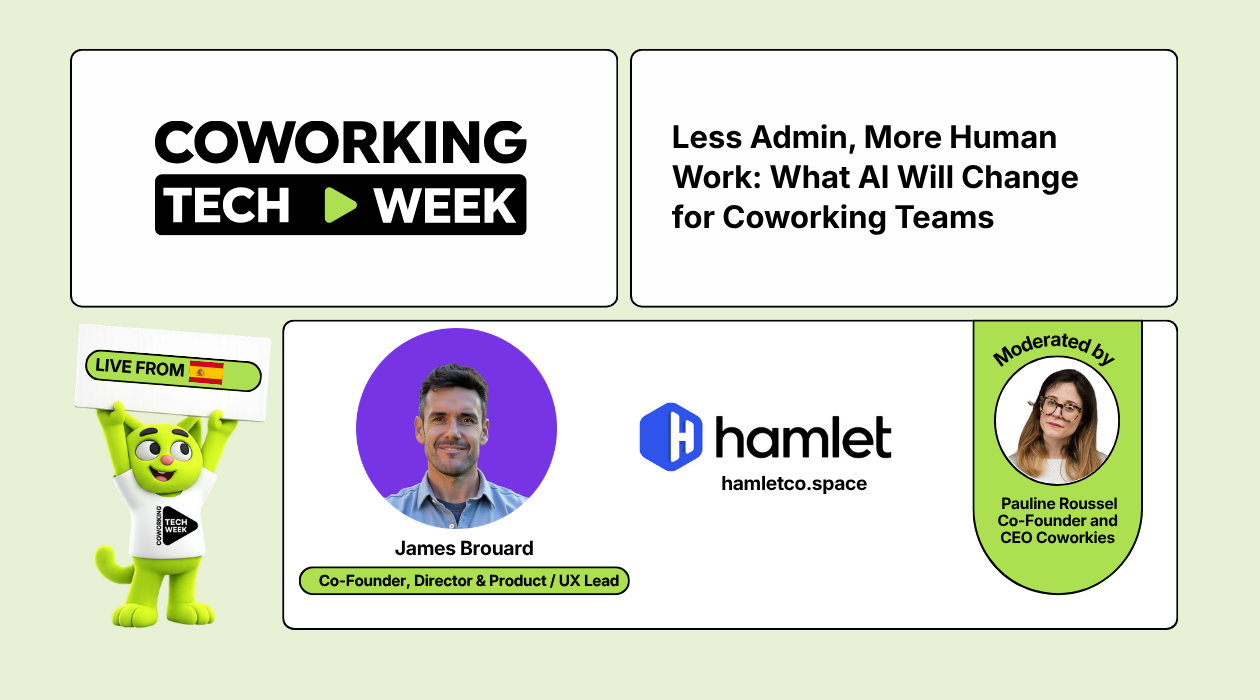
This article is based on the Coworking Tech Week replay, Less Admin, More Human Work: What AI Will Change for Coworking Teams, featuring James Brouard, Co-Founder, Director, and Product/UX Lead at Hamlet. The replay is especially useful for operators who want AI to improve daily workflows without weakening the hospitality and personal attention that make coworking valuable.
The hidden admin load
Community managers are often hired for people work, but much of the day can disappear into admin: invoices, bookings, support requests, repeated questions, operational follow-up, handoffs, reminders, and small exceptions.
That creates a real tension inside coworking. The business depends on hospitality, presence, and responsiveness, yet the team can spend the majority of its attention inside systems. James Brouard frames AI as a way to reduce that low-value repetition so teams can return more attention to members.
This is the practical version of AI in coworking. The question is not whether AI is impressive. The question is what it removes from the day so community teams can notice more, respond sooner, and create a better atmosphere.
Why Hamlet starts with real operator frustration
James brings a useful perspective because Hamlet grew from real operator frustrations with fragmented tools, manual processes, and limited software options. He first experienced coworking as a member before helping build software for the industry.
That background matters. The session does not treat AI as a detached product trend. It starts with the actual workflow problems that make coworking teams less effective: information spread across tools, repeated admin, weak shared context, and software that does not always match how teams work.
For product teams building coworking software, that is an important lesson. AI should not be layered on top of unclear workflows. It should help solve the operational problems teams already feel.
What AI can take off the team
James makes a useful distinction between transactional and relational work.
Transactional work includes invoice reminders, repeated FAQs, simple booking questions, routine follow-up, summaries, support triage, and other tasks where the right answer is usually known. These are good candidates for automation or AI assistance because they are repetitive and do not always require deep judgment.
Relational work is different. Handling a frustrated member, resolving a sensitive booking conflict, reading the mood of the space, or deciding how to approach a delicate conversation requires human judgment. AI may help prepare context, summarize history, or suggest options, but a person still needs to decide how to respond.
That distinction helps operators avoid two bad extremes: automating too little because AI feels risky, or automating too much because efficiency looks attractive on a spreadsheet.
Why shared team context changes the value
Many people use AI as an individual productivity tool. Coworking is a team environment, so the bigger opportunity is shared context.
AI becomes more useful when it can work with shared inboxes, member history, lead conversations, internal notes, tasks, and operational knowledge. A community manager should not have to ask a colleague what happened with a member yesterday if the system can summarize the relevant context. A site lead should not have to rebuild the week from scattered messages if software can surface what needs attention.
This is also where coworking teams need to be thoughtful about data and process. If member history is incomplete, lead conversations are fragmented, and notes are inconsistent, AI will have less to work with. Better automation often starts with better shared information.
The interface is becoming more conversational
The session also looks at how coworking management software may change. James expects more workflows to become conversational: teams asking software direct questions, requesting reports, summarizing issues, or surfacing what needs attention that day.
Traditional dashboards and records will still matter. Operators need reliable source data and structured views. But conversational tools can make common workflows easier to reach, especially for busy teams who need an answer quickly rather than another screen to interpret.
This could change the feel of daily work. Instead of clicking through several areas of a platform, a manager might ask which members have unresolved issues, which invoices need attention, which bookings look unusual, or what should be prioritized before the morning rush.
What should stay human
The strongest part of the Hamlet replay is its caution around over-automation. In coworking, small human touchpoints often carry more value than they appear to on a process map.
A member who is annoyed about a room conflict may not need the fastest possible automated response. They may need someone to listen, understand the context, and make a judgment call. A quiet shift in the atmosphere of a room is not something software can read reliably. A welcome at the right moment, a check-in with someone who seems off, or a thoughtful resolution after a mistake can shape whether a member feels looked after.
Automation should create more capacity for that work, not remove it. If AI makes the team less present, less observant, or less trusted, the operator has automated the wrong thing.
Where operators should start
We would begin with tasks that are repetitive, measurable, and low-risk:
- Repeated support questions.
- Simple booking updates.
- Invoice reminders and payment follow-up.
- Summaries of shared inbox conversations.
- Drafts for routine member communication.
- Internal handoff notes.
- Daily priority summaries for the team.
Then review what should remain personal:
- Frustrated member conversations.
- Sensitive billing or contract discussions.
- Booking conflicts affecting trust.
- Hospitality moments that define the space.
- Decisions that require reading context in the room.
The future James describes is not a teamless coworking space. It is a calmer, more proactive community team. AI can surface priorities, reduce repetitive admin, support decision-making, and help software teams respond faster to real operator needs. The human work remains central, with more time available for it.
Watch the full Coworking Tech Week replay with James Brouard for the complete Hamlet discussion on admin automation, shared context, conversational software, member experience, and where human judgment still matters.

Written by
Dimitar InchevCo-Founder & CTO at Coworkies
Dimitar Inchev is Co-Founder and CTO at Coworkies, writing about coworking technology, operations, community building, and workspace growth.