Why Multi-Market Coworking Operators Need One Operational View
A single coworking space can hide a surprising amount of operational friction inside spreadsheets, inboxes, calendar notes, and staff memory. A multi-market operator cannot. Once a business grows across locations, teams, countries, tax rules, currencies, products, and reporting lines, disconnected systems stop being a small inconvenience and start becoming a management risk.
TL;DR
- Multi-market coworking operators need visibility from lead to invoice. Sales, contracts, onboarding, billing, reporting, renewals, and member account health have to connect if leadership wants a reliable view of the business.
- Revenue leakage often hides in ordinary workflows. Missed deposits, meeting room credits, discounts, add-ons, contract terms, and late renewals can become material when they happen across several locations.
- AfricaWorks shows why timing matters. The operator invested in a stronger system before further expansion made training, reporting, and communication harder to control.
- Software implementation is a leadership project. Team adoption, process clarity, training, and internal buy-in matter as much as the platform itself.
- AI only becomes useful after the data foundation is clean enough. Recommendations are more valuable when they are based on live operational data, not disconnected exports.
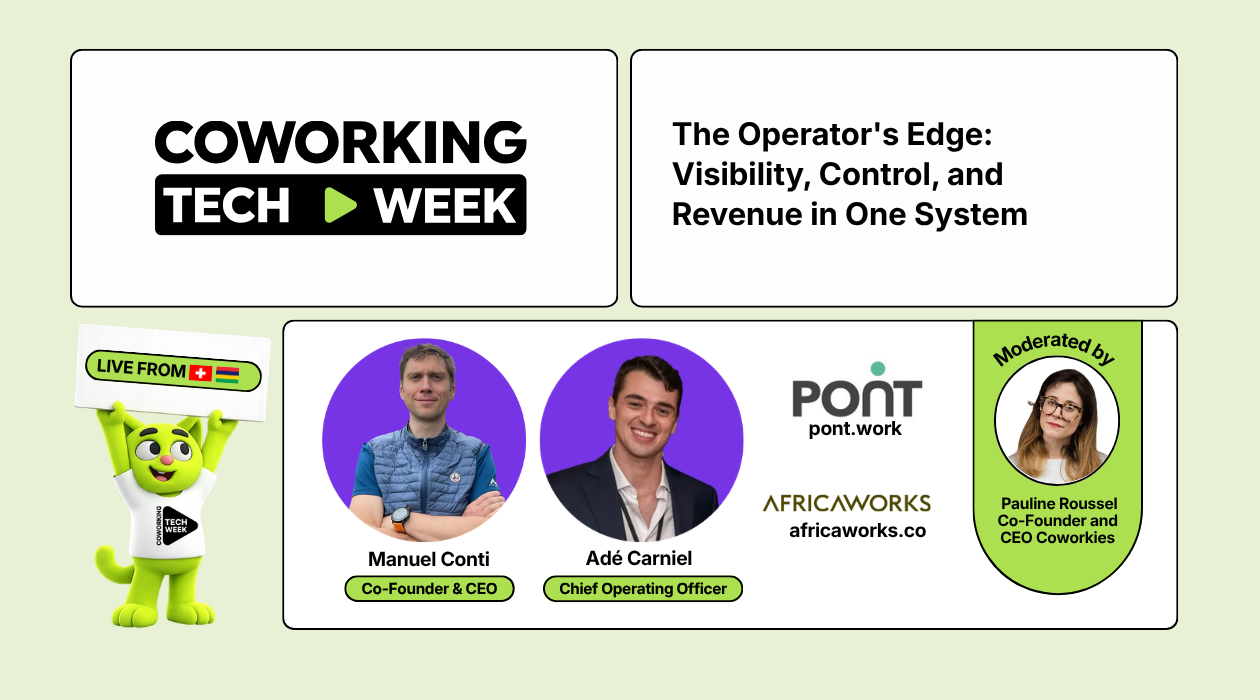
This article is based on the Coworking Tech Week replay, Running Your Coworking Space on One System, featuring Manuel Conti, CEO and Co-Founder of PONT, and Adhéaume Carniel-Perrin, COO of AfricaWorks. The full session is a useful case study for operators evaluating coworking management software, automation, dashboards, billing control, and multi-country growth.
The hidden cost of disconnected tools
The most dangerous admin problems in coworking rarely announce themselves as strategic issues. They look like a deposit nobody chased, a meeting room credit that was never invoiced, a contract term that sat in the wrong spreadsheet, a report that took a full day to prepare, or a sales handover where the ball quietly dropped.
That is why the PONT and AfricaWorks conversation is useful. It does not treat coworking software as a nice operational upgrade. It frames the operating system as the place where revenue, accountability, and daily work become visible.
Manuel Conti describes the problem many operators know well: one tool for sales, another for contracts, another for invoicing, separate dashboards for reporting, and a lot of human effort spent reconciling the gaps. The result is a “ping-pong” effect between teams. Information moves, but not always cleanly. Work happens, but leadership cannot always see what stage a customer is in or what needs to happen next.
For operators thinking through how to build a coworking tech stack, this is one of the first questions to ask: does the stack make the business easier to see, or does it only add more places where information can drift?
What an operational system has to connect
PONT is presented in the session as an all-in-one operating system for coworking and flexible workspace businesses. The important idea is not simply that everything sits in one product. The important idea is that the customer journey has to connect from the first lead through quote, contract, onboarding, invoice, reporting, member management, renewals, and account health.
In a growing operator, those moments often belong to different people. Sales may own the opportunity. A community team may own onboarding. Finance may own invoicing. Management may own reporting. If each team sees only its own slice, the business depends on manual handovers, repeated checks, and individual memory.
The value of one operational view is that each team can work from the same source of truth. Sales can see deal stage. Community can see when a new member is ready to onboard. Finance can see the correct billing details. Leadership can see conversion, occupancy, revenue, staff time, location performance, and product performance without rebuilding the business every week in a spreadsheet.
This is where a general coworking tech stack conversation becomes more specific. A growing operator does not only need tools. It needs an operating model the tools can support.
Why AfricaWorks needed a stronger foundation
AfricaWorks makes the session more concrete because the company operates coworking and coliving across seven African countries. Adhéaume Carniel-Perrin describes a business dealing with different markets, teams, currencies, tax rules, customer needs, logistics, and growth pressure.
Before implementing PONT, AfricaWorks relied heavily on Excel, complex dashboards, manual communication, and internal effort to keep the business moving. Adhéaume explains that this destroyed value because staff were spending too much time on work that should have been automated or made easier to control.
The timing matters. AfricaWorks was preparing for substantial growth after investment, and the team wanted a stronger foundation before expansion made the system harder to change. That is an important lesson for any operator preparing to open more locations or enter new markets. Waiting until the business is already stretched can make implementation more painful, because every process is already under pressure.
Where revenue leakage shows up
Revenue leakage in coworking is often boring, which is why it gets missed. It can appear in deposits, credits, discounts, meeting room usage, add-ons, contract changes, unpaid invoices, renewal dates, price indexation, and product performance. One mistake may not feel urgent. Repeated across locations and teams, it can become serious margin loss.
The replay includes several concrete examples. Manuel mentions operators discovering unpaid deposits and teams spending a full day each week preparing reports manually. AfricaWorks found meeting room credits that had not been invoiced correctly in the first week of implementation. Adhéaume says recovering that missed revenue effectively covered the cost of PONT in that first week.
He also describes a dramatic reduction in communication around deal signing: from roughly 50 to 60 emails down to around four. AfricaWorks estimated saving around 164 staff hours per week, which Adhéaume compared to about four full-time employees. The important point was not headcount reduction. It was that those hours could move back into sales, service, checks, outbound activity, and community work.
This is why the “cost” of coworking software should be evaluated against the cost of manual work and missed revenue. A platform that prevents billing mistakes, shortens deal cycles, improves reporting, and gives teams time back may have a very different ROI than its monthly subscription suggests.
Team adoption is part of the system
The implementation story in the session is intentionally realistic. AfricaWorks did not describe a frictionless switch. The process took around two to three months of intense work, and the team was skeptical at first because they had experienced failed systems before.
That skepticism is normal. New software changes routines, responsibilities, visibility, and sometimes power inside an organization. If the leadership team treats implementation as a vendor task, adoption will suffer. If the operator treats it as an operating change, with training, explanation, process design, and proof that work becomes easier, the odds improve.
Adhéaume says that after implementation, most team members he spoke with felt the system was clearly better than before. That matters because the best software decision is still fragile if teams do not trust the process. A scalable coworking system has to work on the floor, not only in a management dashboard.
AI comes after operational visibility
The session discusses AI, but only after the operational foundation is clear. That order is important.
PONT’s AI layer is described as useful because it can work from the operator’s own live data: leads, deals, bookings, availability, products, occupancy, and revenue signals. That makes it different from asking a generic AI tool to reason from fragmented exports or incomplete context.
The examples are practical: identifying underperforming products, suggesting where sales teams should focus, forecasting availability, supporting A/B test marketing emails, highlighting revenue opportunities, and helping teams make faster decisions. In other words, AI becomes more valuable when the underlying system already understands what is happening in the business.
For operators, this is a useful filter. If the current data is inconsistent, manually reconciled, or split across too many tools, AI may produce more noise than insight. The first job is visibility. Intelligence comes after that.
When to move beyond spreadsheets
We would not tell every small coworking operator to buy a complex system immediately. Early-stage spaces often need to learn their market before they automate everything. But there is a clear moment when spreadsheets stop being lightweight and start becoming risk.
That moment has usually arrived when:
- Sales, contracts, invoicing, and onboarding are owned by different people.
- Reports take hours or days to prepare manually.
- Deposits, credits, add-ons, or meeting room charges are being checked by hand.
- Leadership does not trust the numbers without reconciliation.
- Teams across locations are using different processes for the same work.
- Renewal dates and member account health are not visible early enough.
- Growth plans require faster training and repeatable workflows.
The PONT and AfricaWorks replay is valuable because it shows the decision from both sides: a software founder who understands fragmented operations, and a COO who needed a system strong enough for multi-country growth.
Watch the full Coworking Tech Week replay with PONT and AfricaWorks for the complete discussion, implementation details, and examples from Manuel Conti and Adhéaume Carniel-Perrin.

Written by
Dimitar InchevCo-Founder & CTO at Coworkies
Dimitar Inchev is Co-Founder and CTO at Coworkies, writing about coworking technology, operations, community building, and workspace growth.