What Japanese Coworking Operators Teach Us About Practical Technology
The most useful lesson from Japanese coworking operators is simple: a global tech stack still has to earn its place locally. Tools need to fit member behavior, billing rules, language, staff habits, physical space, and the moments where human interaction matters more than automation.
TL;DR
- Japanese coworking operators use technology to solve practical operational problems. The panel focused on reservations, payments, access control, Wi-Fi, invoicing, member management, and staff time.
- Market fit matters more than feature lists. A tool can work globally and still need adjustment for Japanese billing, language, hardware, local expectations, and team workflows.
- International members need more than translated software. Bilingual staff, culturally aware onboarding, and tools that foreign founders or digital nomads can understand are part of the experience.
- Human touch still beats automation in community work. Trust, context, relationships, and face-to-face conversations cannot be fully replaced by systems.
- Hardware decisions are part of the tech stack. Coffee machines, cables, AV equipment, HVAC, air quality, and room comfort can affect members as much as software does.
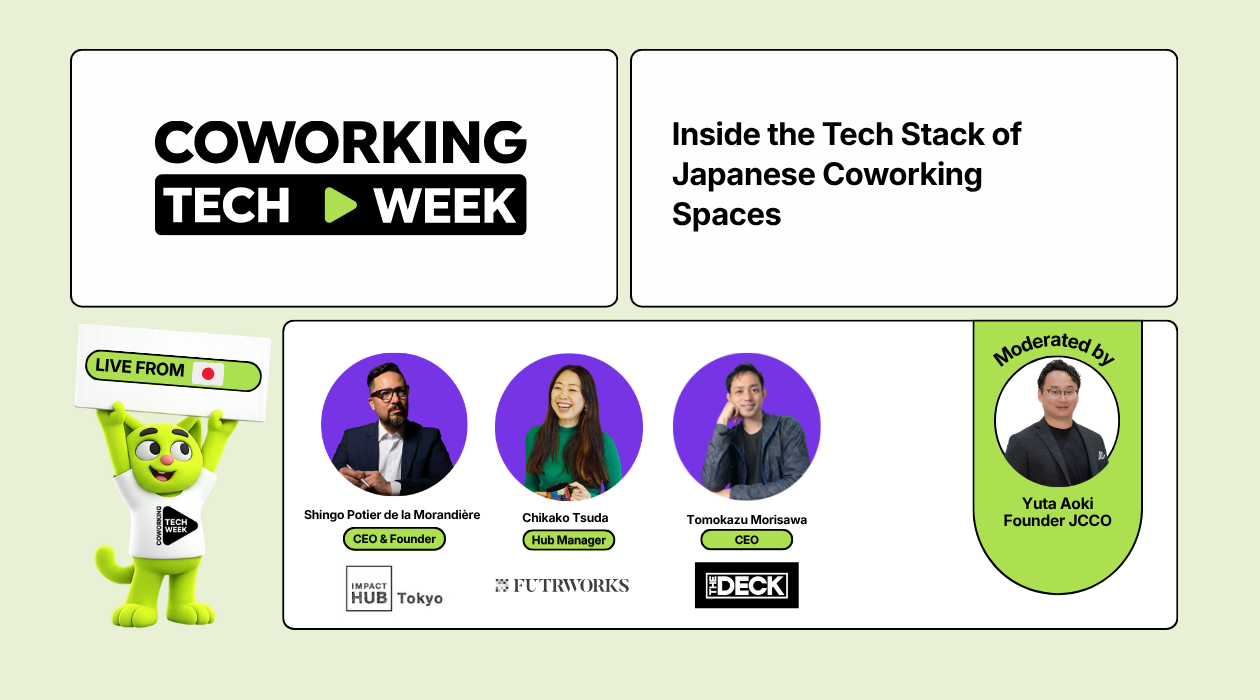
This article is based on the Coworking Tech Week replay, Inside the Tech Stack of Japanese Coworking Spaces, moderated by Yuta Aoki of JCCO with operators from FUTRWORKS Osaka, Impact HUB Tokyo, The DECK Osaka, and CIC Japan. It is one of the most grounded sessions in the program because it treats coworking technology as software, hardware, staff workflow, language, billing, and physical experience.
One global tech stack does not fit every market
It is easy to talk about the best coworking tools as if every operator has the same problem. The Japan panel shows why that is too simple.
The right system depends on the market, the team, the space model, the member base, the billing rules, and the level of international usage. A tool may have the right features but still create friction if it does not fit how the team works or how members expect to interact with the space.
This is why a coworking tech stack audit should include local behavior, not only software categories. The question is not “Do we have access control, booking, CRM, and billing?” The better question is “Do these tools work for this team, in this market, with these members?”
The operators behind the panel
Yuta Aoki frames the session around why coworking spaces adopt technology in the first place. His own example is useful: an operator can begin with simple tools such as Google Forms, Google Sheets, and Google Docs, then need more structure as reservations, external users, and operational complexity grow.
Chikako Tsuda explains that FUTRWORKS uses technology mainly to make the team more efficient. The goal is to reduce repetitive work so staff can spend more time on community-building, member relationships, and supporting startups. FUTRWORKS uses Cobot, partly because the space wanted to support international users from the beginning.
Tomokazu Morisawa compares The DECK and CIC Japan, showing how tool choices differ between an independent coworking space and a larger international operator. Shingo Potier de la Morandiere brings the perspective of Impact HUB Tokyo, which had to solve membership, invoicing, Wi-Fi, and access challenges while coworking was still a newer concept locally.
The operational jobs tech has to do
The panel keeps returning to practical operations: reservations, payments, access control, Wi-Fi, invoicing, locks, member systems, internal notes, and staff communication.
These are not abstract software categories. They are the daily paths members and teams move through. A booking system affects how people reserve rooms. Access control affects whether they can enter smoothly. Wi-Fi affects whether the space feels usable. Invoicing affects trust with corporate clients and members. Internal documentation affects whether staff can find the information they need.
That is why coworking tools should be judged by the friction they remove. If a system saves admin time, improves reliability, and gives community managers more room to focus on people, it earns its place. If it creates confusion, it does not matter how advanced it looks.
International members and bilingual communities
A major theme in the panel is support for international members, foreign founders, digital nomads, and non-Japanese speakers.
The operators are clear that language is only part of the challenge. Bilingual software helps, but so do bilingual staff, clear onboarding, cultural understanding, and community managers who can help people from different work cultures understand expectations.
For spaces serving international members, technology has to reduce uncertainty. Booking, payment, access, invoicing, and communication should be understandable enough that members can start using the space without needing constant translation or one-off explanation.
Where human touch beats automation
The Japan panel is not anti-technology. It is practical about where technology stops.
Community-building, member relationships, personal context, and trust still depend on direct human interaction. Tools can store notes and share information internally, but they cannot fully replace the context built through conversation.
Shingo also points to the design of the physical space as part of the experience. Kitchens, entrances, and informal meeting points can create natural interaction. A fully automated space can feel cold if there is too little human presence.
This echoes a wider pattern across the Coworking Tech Week replays: the best technology gives teams more time for human work. It does not try to turn the whole space into a machine.
Hardware mistakes are tech stack mistakes
One of the most useful parts of the panel is the discussion of bad investments.
The examples are ordinary: coffee machines, cheap cables, adapters, AV setup, meeting-room equipment, and air conditioning decisions that do not match real usage. But these are exactly the things members experience every day.
Coworking technology is not only a dashboard. It is also whether the meeting room works, the cable is reliable, the coffee machine does not slow people down, the room temperature is comfortable, and the space supports the kind of work people came to do.
Shingo’s point about air conditioning, humidity, smell, air quality, and temperature is especially important. Physical comfort is part of the product. It may not look like software, but it affects whether members stay.
Billing is more complex than it looks
The panel closes with a topic that many operators underestimate: billing and invoicing in Japan.
Coworking revenue streams can include memberships, day passes, meeting rooms, events, corporate clients, grants, international payments, and partnerships. Each one may create different accounting, tax, and invoice requirements.
That complexity makes billing software and processes more important than they look from the outside. It also explains why global tools need careful local adaptation. A billing workflow that works in one country may not be enough for another market’s accounting expectations.
The broader lesson is not Japan-specific. Every operator should choose tools with the market in mind. Technology should protect staff time, support members, fit local operations, and leave room for the human relationships that make coworking work.
Watch the full Coworking Tech Week Japan panel for the complete discussion on reservations, payments, access, Wi-Fi, invoicing, bilingual communities, Cobot, hardware mistakes, HVAC, and the human side of coworking operations.

Written by
Dimitar InchevCo-Founder & CTO at Coworkies
Dimitar Inchev is Co-Founder and CTO at Coworkies, writing about coworking technology, operations, community building, and workspace growth.