A 90-Day AI Plan For Coworking Operators
AI adoption in coworking does not need to start with a large transformation project. For most teams, the better starting point is a short list of repetitive tasks that already slow the business down: support questions, event promotion, recurring posts, unpaid invoices, room performance, and daily reporting.
TL;DR
- A useful AI rollout starts with daily admin load. Spacebring's session points to bookings, billing issues, member questions, tickets, emails, and coordination as practical starting points.
- Generic AI tools lack coworking context. They can help with writing, but they do not automatically know members, rooms, guides, invoices, support tickets, events, products, or space rules.
- Lem is Spacebring's AI coworker inside the platform. Its value comes from using data already in Spacebring, including guides, tickets, bookings, events, members, products, and analytics.
- The 90-day plan is simple. Month one: member support. Month two: community and events. Month three: revenue insight and decision support.
- Measure saved time, response speed, content consistency, and better answers from data. The goal is less admin and more time for sales, member experience, and community work.
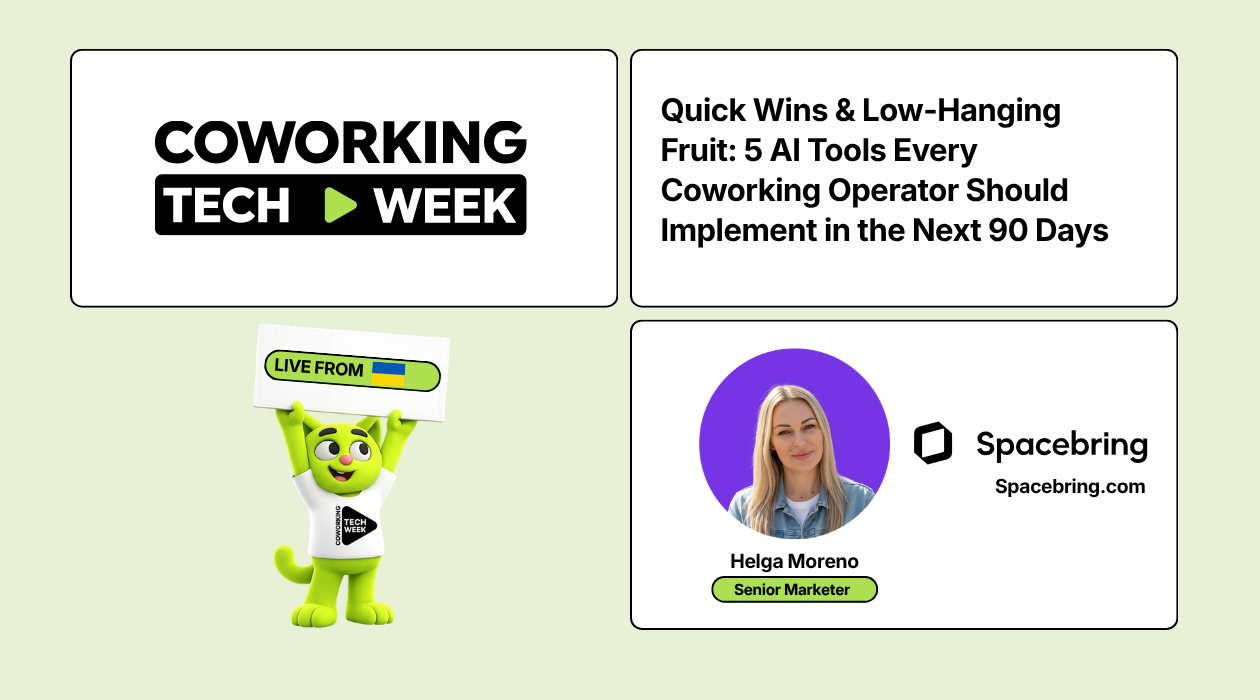
This article is based on the Coworking Tech Week replay, Spacebring Quick Wins & Low-Hanging Fruit: 5 AI Tools Every Coworking Operator Should Implement in the Next 90 Days, featuring Helga Moreno, Senior Marketer at Spacebring. The replay introduces Lem, Spacebring’s AI coworker, and offers a practical path for teams that want AI benefits without adding more complexity.
Start with the admin load
Coworking teams rarely need more software for its own sake. They need fewer repetitive tasks pulling them away from sales, service, members, events, and partnerships.
Helga Moreno opens the Spacebring session with that reality. Spacebring’s research with 200 coworking space owners found that 60% said they were drowning in repetitive manual tasks. Those tasks include bookings, billing issues, member questions, support tickets, emails, and daily coordination.
That makes the AI question much more practical. Instead of asking how AI will change the whole business, ask where the team loses time every day. A good first AI use case should be visible, repetitive, and easy to compare against the current process.
Why context matters more than the model
Generic AI tools can help with writing, brainstorming, and editing. But inside a coworking business, they usually lack the context that makes an answer operationally useful.
A general chatbot does not automatically know the space’s members, rooms, products, tickets, invoices, benefits, guides, event calendar, location details, or internal rules. The team has to explain the context first, and even then the output may not be connected to what is actually happening in the business.
That is why AI for coworking should be evaluated differently from personal productivity AI. The best use cases connect to the operator’s real workflows and data. This is also why a wider AI in coworking strategy should begin with the tech stack and operating process, not only the model.
What Lem adds inside Spacebring
Lem is Spacebring’s AI assistant built into the platform. Helga describes it as an AI coworker that can support member service, content creation, event promotion, ticket routing, and business reporting.
The important point is that Lem works with data already inside Spacebring: guides, tickets, bookings, events, products, members, and analytics. That means an operator does not have to manually upload or explain every detail before asking a question.
The session also stays careful about claims. Lem is part of Spacebring and is not a standalone tool for other platforms. Helga also clarifies that Spacebring’s broader 60% to 10% time-saving ambition comes from the company’s automation experience and case studies, while Lem is still in beta and being improved with customer feedback.
That distinction matters. AI should be measured honestly, especially when operators are deciding whether it can reduce workload without creating new risk.
Month one: member support
The first month should focus on member support because the work is repetitive, visible, and easy to test.
Start with the questions members ask most often. Access instructions, Wi-Fi, printing, meeting room bookings, invoices, plan details, opening hours, guest policies, and late arrivals are all common examples. In the replay, Helga uses the scenario of a new member arriving late and struggling with digital access. An AI assistant can answer clear questions using the space’s own guides and support history, while more complex issues are escalated to the team.
For operators, the practical work is to clean up the source material. AI support is only as useful as the guides, policies, and ticket history it can draw from. If the help content is outdated, confusing, or split across too many places, the first month should include fixing that knowledge base.
Month two: community posts and events
The second month should move into community communication, events, and recurring activities.
Many coworking teams know they should post more consistently about events, benefits, products, member opportunities, and community activity. The problem is time. Starting from a blank page every week creates friction, especially for small teams.
Lem can help draft posts for events, benefits, and shop products using details already stored inside Spacebring. It can also help duplicate recurring events, update details, place them into the calendar, and prepare promotional content. Helga gives the example of a recurring Friday pizza event, which is exactly the kind of small but repeated community task that can quietly take up too much time.
The goal is not to make every community message sound automated. The goal is to remove the blank-page problem so the team can spend more time shaping the message and less time assembling the basics.
Month three: revenue questions and decisions
The third month should focus on data questions that usually require exports, spreadsheets, or manual reports.
Operators should be able to ask practical questions: Who has unpaid invoices? Which room generated the most revenue? What was the busiest day last month? Where are late payments appearing? Which products are underperforming? Which recurring bookings are changing?
If those answers are trapped in CSV exports, teams ask them less often. If AI can turn platform data into useful answers, charts, and lists, decision-making becomes faster. This is where AI begins to support management, not only daily admin.
For teams with a messy setup, the replay’s advice is to step back and do a coworking tech stack audit. AI will be more useful when the underlying tools, data, and workflows are clearer.
What to measure
A 90-day AI rollout should be measured like an operations project, not a novelty test.
We would track:
- How many support questions AI answers without escalation.
- Whether members receive faster answers outside staffed hours.
- How much time the team saves on recurring posts and event setup.
- Whether community communication becomes more consistent.
- How often operators use AI to answer data questions.
- Whether invoice, room performance, and late payment insights are acted on faster.
- Whether the team feels less buried in repetitive work.
The value of AI in this context is not theatrical. It is practical. If the team saves time, members get clearer answers, the community feed stays active, and managers can ask better questions of their data, AI is doing useful work.
Watch the full Coworking Tech Week replay with Helga Moreno for the complete Spacebring discussion, including Lem examples, Q&A, early use cases, and the full 90-day rollout plan.

Written by
Dimitar InchevCo-Founder & CTO at Coworkies
Dimitar Inchev is Co-Founder and CTO at Coworkies, writing about coworking technology, operations, community building, and workspace growth.