Where AI Actually Helps Coworking Operators Today
The useful question about AI in coworking is not whether operators should be paying attention. They already are. The more useful question is where AI saves time, improves a decision, catches something earlier, or gives a team more room to focus on members.
TL;DR
- AI is most useful when it has coworking context. Support tickets, bookings, invoices, pricing, member behavior, feedback, access, and room usage all become more useful when the system understands the operator's real data.
- Support automation is one of the clearest starting points. AI can help answer repeated questions about Wi-Fi, printing, bookings, refunds, plans, and platform use.
- Retention signals are a strong AI use case. AI can help teams spot disengaged members, repeated complaints, support patterns, and behavior changes before churn becomes visible.
- Dynamic pricing and room booking need operator judgment. AI can surface patterns, but the team still decides how pricing, availability, and member experience should work.
- The best use of AI protects hospitality. Automation should remove repetitive work so staff have more time and better information for human service.
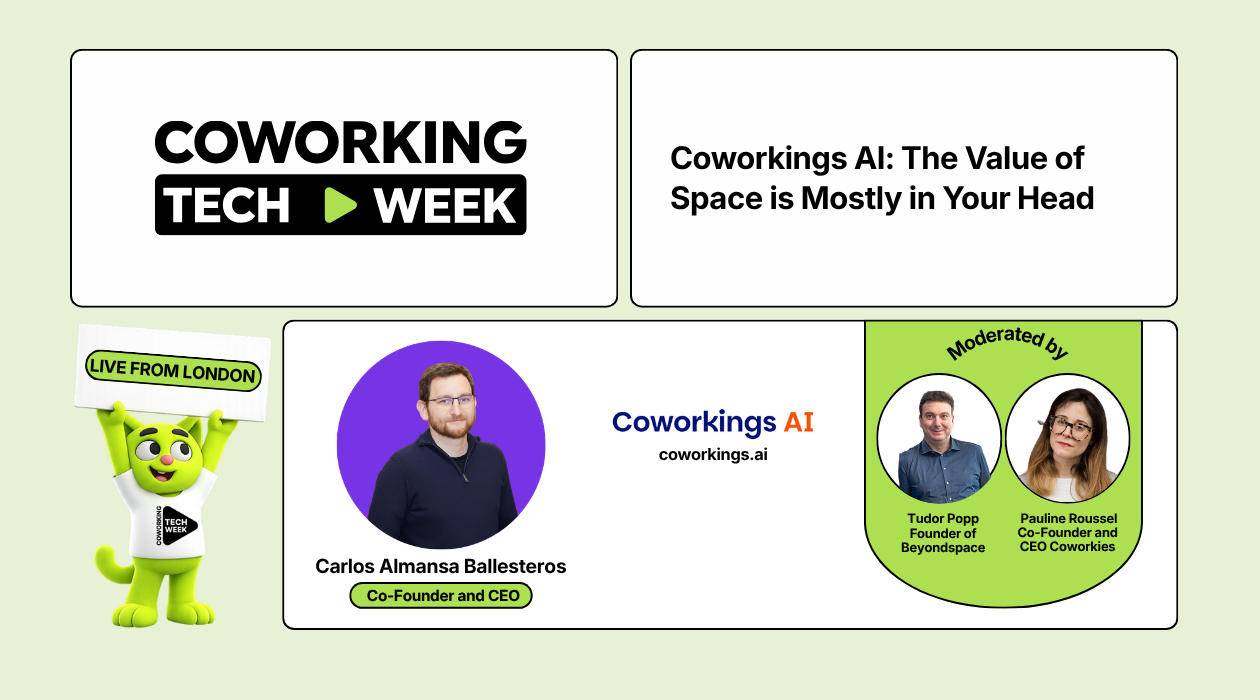
This article is based on the Coworking Tech Week replay, Coworking AI: The Value of Space is Mostly in Your Head, featuring Carlos Almansa Ballesteros, Co-Founder and CEO of Nexudus, with Tudor Popp from Beyond Space joining the discussion. The replay is a grounded look at how AI is entering coworking software, member support, dynamic pricing, IoT, retention, AI agents, and the design of physical workspace.
Start with the work that repeats
AI becomes more useful when operators stop treating it as a broad transformation question and start with the work that repeats every week.
Community teams answer the same questions about Wi-Fi, printing, meeting room bookings, invoices, refunds, access, and plans. Managers read feedback and support messages looking for patterns. Sales teams qualify leads. Operators compare room usage, availability, event attendance, product performance, and member behavior. Much of this work is not strategically difficult, but it consumes attention.
That is where AI can help today. It can organize information, draft answers, surface patterns, and give teams a faster starting point. It does not remove the need for operator judgment, but it can reduce the time spent gathering the same context again and again.
For readers looking at the broader AI in coworking opportunity, this is the practical frame: start where the work is repetitive, the data already exists, and the team knows what good looks like.
Why coworking context matters
One reason the Nexudus conversation is useful is that Carlos keeps bringing AI back to coworking context. Generic tools can be helpful, but coworking operators need AI that understands bookings, memberships, meeting rooms, support tickets, pricing, plans, access control, feedback, events, and the rhythm of a physical space.
Nexudus has worked on machine-learning-style features before the current AI wave, including forecasting for meeting rooms. The difference now is pace. AI has made experimentation faster, and the number of possible use cases has expanded quickly.
That speed creates confusion for operators. To help with that, Nexudus launched Coworkings.ai, a resource for practical AI use cases in the flex space industry. The important word is practical. Operators do not need another abstract AI trend page. They need examples connected to real support, data, pricing, member experience, and operations.
Support automation is the obvious first step
Support is one of the cleanest AI entry points because the pain is easy to see. Members ask how to connect to Wi-Fi, how to print, how to book a room, how to change a plan, how to refund an invoice, or how to use the platform. These questions are important, but many are repeated.
AI can help members get faster answers, especially outside staffed hours. It can also help community teams by drafting replies, summarizing requests, and identifying repeated issues. If several members keep asking the same question, the problem may not be the question. It may be signage, onboarding, documentation, or product design.
This is where support automation moves beyond efficiency. A good AI system can show operators where the member experience is unclear. The goal is not to hide the team behind a bot. The goal is to remove avoidable friction and help staff spend more time on the conversations that actually need a person.
Retention starts with earlier signals
Member retention is another strong use case because churn rarely appears from nowhere. It often follows weaker visit patterns, repeated complaints, lower event participation, unpaid invoices, unused bookings, or a series of small support issues.
For smaller spaces, a strong community manager may notice those patterns directly. For larger spaces or multi-location operators, it becomes harder to track every signal manually. AI can help by scanning behavior across bookings, support requests, feedback, engagement, and usage, then highlighting members who may need attention.
The human role remains central. AI may identify a pattern, but the team decides how to respond. A disengaged member may need a check-in, a different plan, help using the space, a better room setup, or simply a warmer conversation. The value is earlier visibility, not automated relationship management.
Pricing, bookings, and building data need better inputs
The replay also covers dynamic pricing, room booking, IoT, access control, HVAC, occupancy data, air quality, and environmental sensors. These areas are attractive because they promise better use of space, but they also depend heavily on data quality and integration.
Carlos explains that dynamic pricing has existed in Nexudus for years, but adoption has grown gradually as operators have become more comfortable using data to adjust pricing and availability. That makes sense. Pricing affects trust, sales, operations, and member expectations. AI can help identify patterns, but operators still need to decide what pricing behavior fits their brand and market.
Room booking is another practical example. A member should be able to ask naturally for a room at a specific time and receive relevant options without navigating filters and menus. That kind of experience depends on accurate availability, room data, plan rules, pricing, and booking logic.
Building data is similar. Sensors, access control, occupancy, printing, air quality, and environmental systems can all make operations smarter, but many buildings still have fragmented property technology, legacy infrastructure, and cost barriers. AI can only help if the underlying systems provide usable signals.
AI agents need onboarding too
One of the best comparisons in the session is Carlos describing AI agents like new team members. They need onboarding, context, and boundaries.
A sales agent needs to understand the space, plans, tone of voice, qualification process, pricing rules, handoff points, and what not to promise. A support agent needs to know which questions it can answer, when to escalate, and how to avoid low-quality or unsafe responses. A platform assistant needs enough context to help an operator configure plans, products, resources, or settings without making a mess.
This is especially important for customer-facing AI. Operators need guardrails around what the assistant can answer, how it handles bad inputs, and when a human should step in. Poor tone or overconfident answers can damage trust quickly in a hospitality business.
A practical AI roadmap for operators
We would start small and build from the operator’s actual work.
For a small coworking space, the first step might be:
- List the 20 questions members ask most often.
- Review support messages and feedback for repeated issues.
- Use AI to draft better onboarding, help content, event descriptions, and email responses.
- Test AI internally before allowing it to answer members directly.
- Measure whether the team saves time or members get clearer answers.
For a larger operator, the roadmap may include:
- Cleaning data across bookings, support, billing, plans, events, and member records.
- Identifying churn signals and account health indicators.
- Testing dynamic pricing or room recommendations in a controlled way.
- Reviewing IoT and building integrations only where the business case is clear.
- Training AI agents with specific roles, boundaries, escalation rules, and human review.
The main lesson from the Nexudus session is that AI is valuable when it helps operators understand and act on the business they already run. It can process more information, speed up responses, find patterns, and make software easier to use. It should not flatten the hospitality that makes coworking valuable.
Watch the full Coworking Tech Week replay with Carlos Almansa Ballesteros for the complete discussion on AI use cases, Coworkings.ai, member support, retention, dynamic pricing, IoT, AI agents, and the future design of coworking spaces.

Written by
Dimitar InchevCo-Founder & CTO at Coworkies
Dimitar Inchev is Co-Founder and CTO at Coworkies, writing about coworking technology, operations, community building, and workspace growth.