What To Standardize When A Coworking Business Grows Beyond One Site
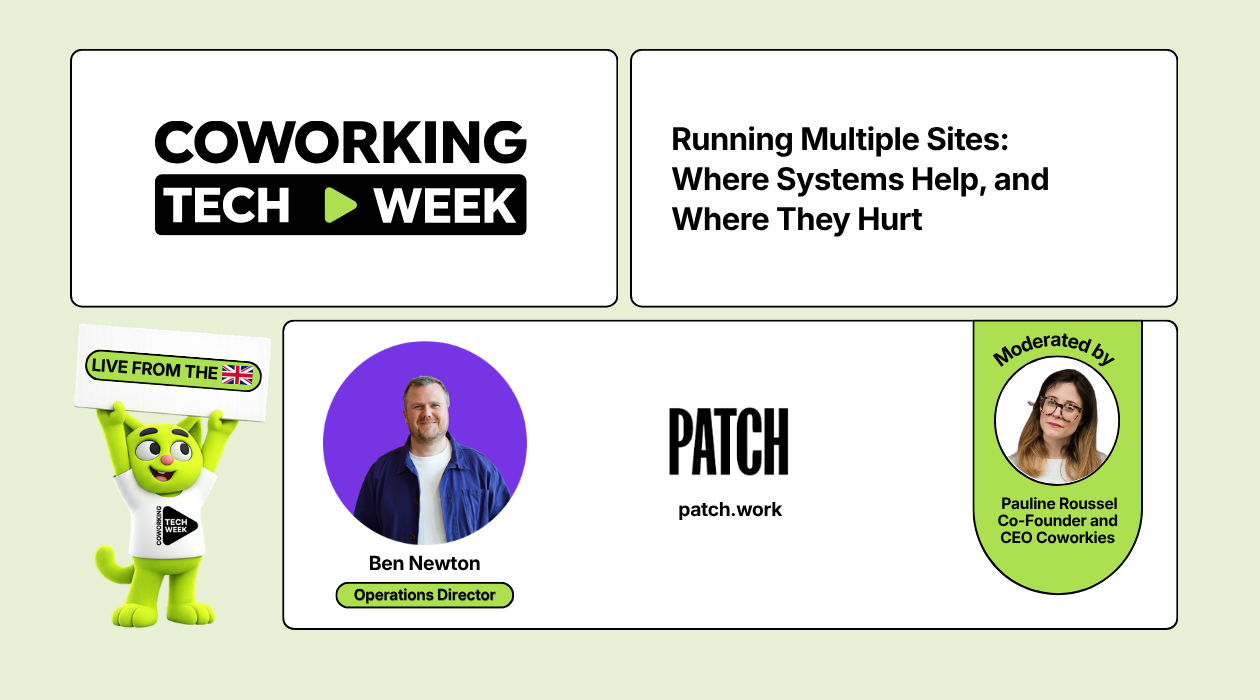
The second location is where many coworking operators discover the difference between running a space and running a business. What worked through founder memory, direct team communication, and informal judgment at one site starts to fray when another building, another team, and another local market enter the picture.
TL;DR
- Multi-site coworking operators need a clear split between standards and local judgment. Billing, compliance, finance, access, safety, data, response standards, and reporting need consistency.
- Local teams need room to shape the experience. Events, partnerships, suppliers, hospitality touches, and community programming work best when people close to the members can make decisions.
- Reporting should support action, not visibility for its own sake. Patch removed or automated reporting that slowed teams without improving decisions.
- Software adoption depends on training and context. Playbooks, Loom videos, internal champions, onboarding checks, and hands-on support help teams use tools under real operating pressure.
- AI is useful behind the scenes when it supports human teams. Patch uses AI for research, strategy support, document review, retention signals, and productivity, while keeping the member experience locally grounded.
This article is based on the Coworking Tech Week replay, Running Multiple Sites: Where Systems Help, and Where They Hurt, featuring Ben Newton, Operations Director at Patch. The full session is a practical operator discussion about growing beyond one coworking site without losing local character or drowning teams in process.
The second-location problem
Opening a second or third site forces a coworking operator to make choices that were easier to avoid at one location. Which systems should be shared? Which decisions should sit with local teams? Which reports are worth the time? Which software choices create consistency, and which ones create more admin?
This is the tension at the center of Ben Newton’s session. Patch needs enough structure to run reliably across multiple neighborhood workspaces, but not so much central control that each site starts feeling generic.
That balance is one of the clearest markers of coworking best practices with technology. High-performing operators do not standardize everything. They standardize the things that protect the business and leave room for local teams to shape the member experience.
Patch's neighborhood workspace model
Patch operates neighborhood workspaces across the UK, combining coworking, events, hospitality, and local community use. The model depends on each site being relevant to its town or neighborhood, not simply repeating the same operating script everywhere.
That local identity creates a useful scaling challenge. A central team can define what the business must know, measure, protect, and repeat. But local teams are closer to members, partners, events, suppliers, and the small rituals that make a space feel active.
For a town-center real estate owner or operator considering a neighborhood workspace model, that distinction matters. Scale should make the business stronger. It should not remove the local intelligence that helped the first space work.
What should be standardized
Patch’s operational baseline includes the areas where inconsistency creates risk or confusion: billing, compliance, finance, health and safety, data protection, access control, reporting, and response standards.
These are not glamorous parts of the business, but they make multi-site growth possible. Members need reliable access. Finance needs clean information. Leadership needs trustworthy reporting. Teams need shared response expectations. Safety and compliance cannot depend on local improvisation.
This is where a multi-site operator’s coworking tech stack has to become more disciplined. Shared systems are valuable when they reduce ambiguity and make the business easier to manage. They are not valuable just because central leadership can ask for more reports.
What should stay local
Patch gives local teams room to shape events, partnerships, suppliers, hospitality touches, and programming. Those choices depend on the community around the building.
The person closest to the members often knows which local partner is worth calling, which event format will work, which supplier understands the space, and which hospitality detail will matter. A central process can support those decisions, but it should not smother them.
This is one reason multi-site coworking operations are different from pure software scaling. A good workspace brand needs shared standards, but each site still has to feel rooted in its place. If every decision is centralized, the operator may gain control while losing the texture that members came for.
When processes start slowing teams down
One of the most useful parts of the replay is Ben’s honesty about reporting. Patch found that some reporting templates and weekly spreadsheets were taking too much time and not always leading to better decisions.
That is a common scaling trap. A central team wants visibility, so it asks local teams for more information. Local teams spend time preparing updates. The business gets more data, but not necessarily more action.
Patch responded by removing or automating reports that mainly existed for visibility and keeping the reporting that supported commercial ownership and decisions. That is a good principle for any operator: if a report does not change a decision, improve a workflow, protect margin, or help a team act sooner, it may be overhead.
Tool adoption is an operations discipline
Patch’s tech stack includes Nexudus for workspace management, Xero for accounting, HubSpot for CRM, Coho for reporting, DoorDeck and Avigilon for access control, PaperCut Hive for printing, Revolut and Dext for expenses, and Google Workspace for collaboration.
The important part is not the list. It is Ben’s rule that every tool has to justify its place by reducing manual work, protecting margin, scaling with the business, or improving the member experience.
Training matters because many coworking teams come from hospitality rather than software-heavy operating environments. Patch uses playbooks, Loom videos, internal champions, onboarding checks, and hands-on support so team members can build confidence before they are under pressure in front of members.
The same logic applies to AI. Patch is using AI behind the scenes for local market research, identifying partners or sales opportunities, drafting and reviewing internal documents, stress-testing decisions, and exploring member retention signals. Ben also shares a useful cautionary example of an AI bot called Pat becoming too forceful in early communications. Tone, transparency, and boundaries matter in a hospitality business.
A scaling checklist for operators
For operators preparing to grow beyond one location, we would take seven questions from the Patch session:
- Which operating standards must be identical across every site?
- Which decisions are better made by local teams?
- Which reports lead to action, and which exist mainly for visibility?
- Which tools reduce manual work or protect margin?
- How will new site teams learn the systems before they are under pressure?
- Where can AI help the team without weakening the human member experience?
- What cost benchmarks do we need before assuming one site model will work in another market?
The final point connects to Open Ops, the cost benchmarking project Ben discusses near the end of the session. Benchmarking cleaning, maintenance, internet, facilities management, and other operating costs could be especially useful for regional and non-city-center spaces where typical assumptions may not apply.
Patch’s lesson is not that every operator needs a heavy central operating model. It is that growth needs a clear baseline. Standardize the parts that protect the business, document how the work gets done, train teams well, review processes before they become drag, and leave enough room for each location to feel genuinely local.
Watch the full Coworking Tech Week replay with Ben Newton for the complete Patch discussion on multi-site operations, software, reporting, AI, local decision-making, and cost benchmarking.

Written by
Dimitar InchevCo-Founder & CTO at Coworkies
Dimitar Inchev is Co-Founder and CTO at Coworkies, writing about coworking technology, operations, community building, and workspace growth.