How The Bureau Built A Coworking Tech Stack Around Real Customer Behavior
The mistake many new coworking operators make is starting with software before they understand how people will actually find, trust, book, and return to the space. The Bureau Business Center in Dubai offers a useful counterexample: its stack grew around local customer behavior, team adoption, and a clear sense of what the business needed next.
TL;DR
- The Bureau built its stack around the customer journey in Dubai. WhatsApp, phone calls, Google, Instagram, referrals, events, and partnerships shape how prospects discover and engage with the space.
- Nexudus became the core coworking platform because it matched operational needs. The team valued ease of use, white-label options, integrations, support, training, and the ability to manage coworking, meeting rooms, events, and business center services.
- Tool adoption mattered more than feature lists. The Bureau stopped using tools that looked good in theory but did not create enough value for the team or customers.
- Marketing and community are part of the stack. Instagram, events, partnerships, HubSpot, Eventbrite, Luma, coworking days, and referral networks all support demand generation.
- The practical lesson for new operators is to choose one tool per purpose. A focused stack can be stronger than a complex one if it reduces friction and supports real business behavior.
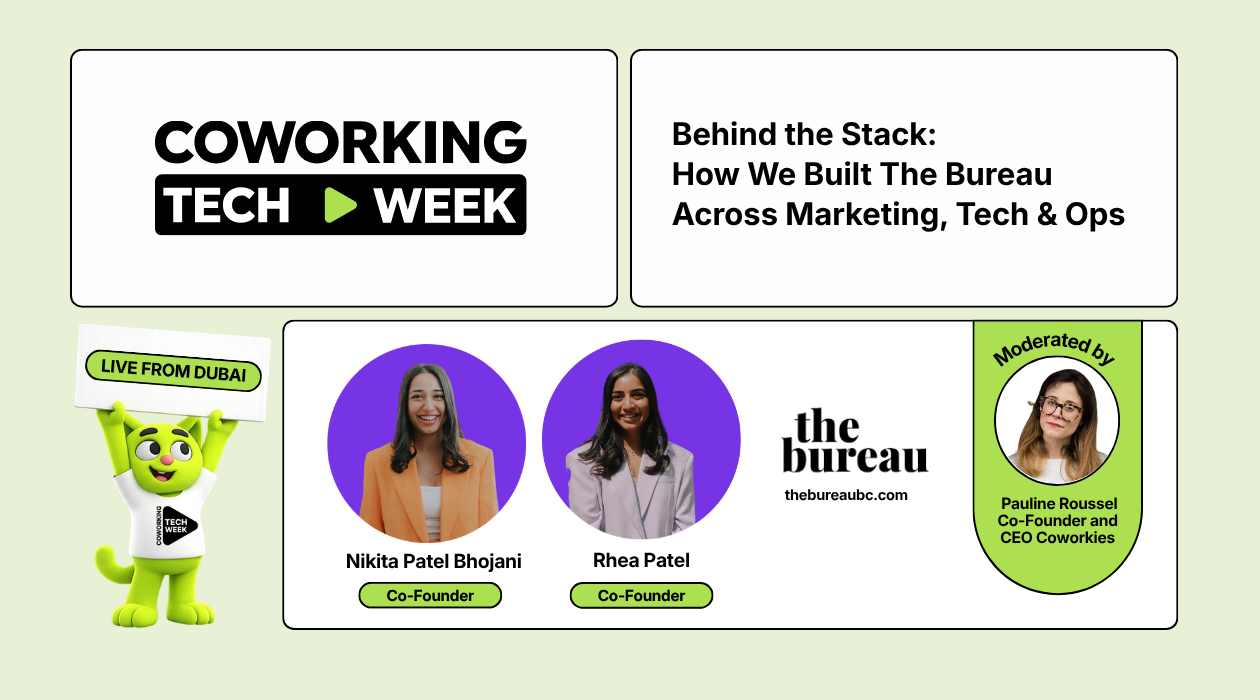
This article is based on the Coworking Tech Week replay, Behind the Stack: How We Built The Bureau Across Marketing, Tech & Ops, featuring Rhea Patel, Co-founder of The Bureau Business Center, and Nikita Patel Bhojani, Co-founder of The Bureau. The full session goes deeper into their software decisions, marketing channels, failed experiments, and early AI use cases.
Start with the way customers buy
The Bureau is a female-focused, community-led coworking and business center in Dubai. Rhea and Nikita started the business after COVID changed how people in the UAE thought about remote and hybrid work. Their market context matters because their technology choices were not abstract. They were shaped by how people in Dubai already communicate.
In the session, they explain that many inquiries still come through WhatsApp. Others arrive through phone calls after someone finds the space on Google. Instagram is not only a brand channel; it is a discovery, trust-building, advertising, partnership, competition, and direct-message channel. Referrals and in-person events also matter because many people convert after experiencing the space, the team, and the community.
That is the first lesson for anyone trying to build a coworking tech stack: the stack should not force prospects into a journey they would never choose. If local buyers use WhatsApp, calls, Instagram DMs, referrals, and community events, the software has to support that reality. Automation is useful only when it makes the path clearer.
Why The Bureau needed a specific coworking platform
The Bureau did not want to run the business on a generic CRM alone. Coworking is customer-facing, but behind the scenes it involves memberships, day passes, meeting rooms, offices, events, payments, printing, invoices, team workflows, customer communication, and reporting.
That led The Bureau to choose Nexudus as its main coworking management software after looking at options including OfficeRnD and Optix. The criteria were practical: the platform had to be easy for the team and customers to use, support white-label customer experiences, integrate with tools such as Google Maps, QuickBooks, Stripe, and printing software, and handle multiple products across coworking, meeting rooms, events, and business center services.
For a new operator, this is where the usual “best coworking software” question becomes more specific. The right answer depends on which workflows are central to the business. A space built around offices, meeting rooms, day passes, events, and community programming will need different operational support than a simple desk-only model. That is why a comparison should go beyond features and look at workflow fit, customer journey, integrations, training, and support.
Support, training, and pricing matter more than operators expect
One of the most useful parts of the conversation is how plainly Rhea and Nikita discuss the difficulty of comparing coworking software providers. Pricing can depend on the number of customers, team users, add-ons, plugins, and usage. For a founder trying to model costs before opening, that makes simple comparison difficult.
Support also became a serious decision factor. If the main platform runs booking, billing, access-related workflows, customer records, and daily operations, a software issue is no longer a small inconvenience. It can affect the member experience and the team’s ability to work. Time zone compatibility, access to a real support person, and early training all mattered because The Bureau was learning both the software and the operating model at the same time.
This is a useful corrective for operators reading a coworking tech stack guide. Software is not only a product. It is also onboarding, documentation, support response, implementation quality, and the provider’s ability to explain the tool in language an operator can act on.
The stack has to pass the adoption test
The Bureau’s approach to adding tools is deliberately restrained. Before adopting something new, the team asks whether it has a clear purpose, reduces steps, supports the bottom line, and will actually be used by staff or customers.
Two examples from the replay are especially useful. The team tried a task management tool, expecting it to centralize internal activity. In practice, the team did not adopt it, so they moved back to simpler Google Sheets for weekly planning. They also tested Loopy Loyalty for day passes, offering a reward after several visits. The idea made sense, but adoption was low and the cost outweighed the value.
That is not a failure of ambition. It is operator discipline. A tool that looks polished can still create noise if the team does not use it or customers do not care. We would treat this as one of the most important early-stage rules: remove tools quickly when they are not earning their place.
Marketing tools only work when they support the channel
The Bureau’s marketing stack reflects where attention and trust already exist. Instagram is a major channel for content, ads, competitions, partnerships, DMs, and lead generation. The team asks new members how they found the space, and social media and referrals are among the most common answers.
Events are another major part of the system. The Bureau hosts workshops and talks for its audience, including sessions around AI tools for mothers and other practical topics. Events bring people into the space, create a reason to experience the brand, and support lead capture. HubSpot helps manage event-related mailing lists, while Eventbrite, Letswork, Luma, and other platforms help widen distribution.
The same thinking applies to sales channels. The Bureau receives coworking leads through Letswork, Deskimo, and Gable, office listing leads through My Office Hub, and has seen ClassPass work unexpectedly well for one downtown location. The point is not that every operator should copy this exact mix. The point is to test channels based on the market, measure what works, and keep the tools that support real conversion.
What new operators should check before adding another tool
If we were using The Bureau session as a practical checklist for a new coworking founder, we would start with six questions.
- Does this tool match how prospects already discover and contact us?
- Does it reduce work for the team or create another place to manage?
- Does it integrate with the core coworking platform, payment system, accounting tools, and communication channels?
- Can the team learn it quickly enough to use it consistently?
- Will customers notice a better experience, or only another app, form, or login?
- Does the cost make sense against saved time, new revenue, fewer mistakes, or better customer experience?
The Bureau’s stack includes practical tools such as Nexudus, Google Workspace, HubSpot, Stripe, QuickBooks, WhatsApp, Instagram, Eventbrite, Luma, coworking marketplaces, listing platforms, and testing channels like ClassPass. But the real lesson is not the list. It is the operating principle behind the list: one tool per purpose, chosen around the way the business actually works.
Their early use of AI follows the same pattern. Rhea and Nikita describe using AI for writing, brand voice, event descriptions, inquiry responses, and customer communication, while still recognizing that niche coworking operations need human judgment and specific support. AI may help with repetitive questions, reporting, maintenance planning, and space planning, but it still needs clear context and a defined job.
For operators comparing tools, the full replay is worth watching because it shows the messy middle that software comparison pages often miss: local behavior, founder judgment, team training, support, underused tools, and the marketing channels that actually bring people through the door.
Watch the full Coworking Tech Week replay with The Bureau for the complete discussion and examples from Rhea Patel and Nikita Patel Bhojani.

Written by
Dimitar InchevCo-Founder & CTO at Coworkies
Dimitar Inchev is Co-Founder and CTO at Coworkies, writing about coworking technology, operations, community building, and workspace growth.