When Reliability Becomes The Product: Lessons From Kooperativ In Kyiv
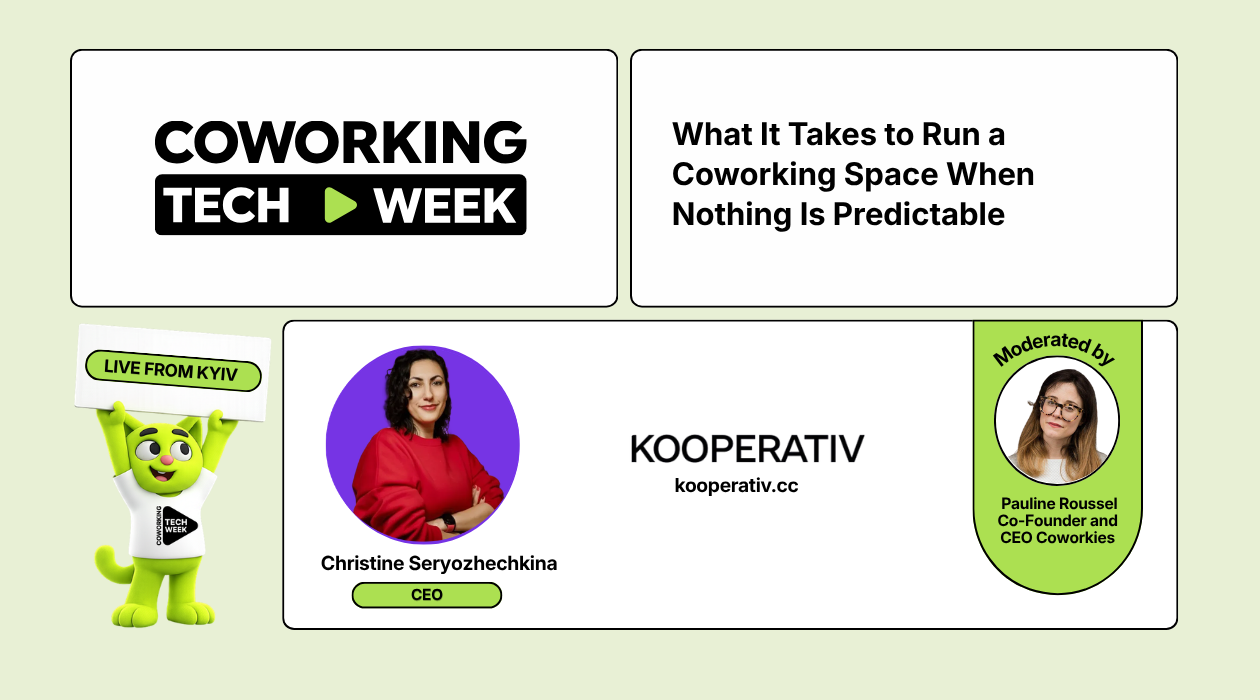
Most coworking operators talk about reliability as a service standard. For Kooperativ in Kyiv, reliability has become something closer to the product itself. When power, water, heat, staffing, and daily routines are uncertain, a workspace is no longer just a place to work. It becomes part of the infrastructure that helps members keep going.
TL;DR
- Kooperativ shows how reliability becomes a member value proposition. In Kyiv, members need power, Wi-Fi, warmth, water, food, coffee, and familiar human support when home and city infrastructure are unstable.
- Resilience has a real operating cost. Backup power, diesel, water planning, maintenance, staffing, and service consistency all affect the business model.
- Technology helps when it reduces work. Kooperativ uses Spacebring for member-facing coworking workflows, ClickUp for internal work and lead tracking, and Salto and U-Prox for access.
- Community needs changed during the war. Members looked for stability, connection, comfort, offline presence, and a place where professional life could continue.
- Mixed-use services create resilience and demand. Events, a rooftop bar, cafe, podcast studio, partnerships, and ambassadors give people more reasons to return to the space.
This article is based on the Coworking Tech Week replay, What It Takes to Run a Coworking Space When Nothing Is Predictable, featuring Christine Seryozhechkina, CEO of Kooperativ in Kyiv. The full session is a practical operating story for founders, community teams, and real estate owners thinking about resilience, mixed-use coworking, infrastructure, hospitality, and member trust.
Reliability is a product promise
In stable markets, operators can sometimes treat infrastructure as background. Power works, internet works, water is available, heating is assumed, and members judge the space on location, design, price, community, and service.
Kooperativ’s reality is different. Christine describes operating through wartime uncertainty, electricity cuts, water supply issues, heating pressure, staffing challenges, and the need to keep essential services available when normal planning no longer applies. In that environment, reliability becomes visible. Members notice whether the Wi-Fi works, whether there is hot food, whether coffee is available, whether the room is warm, and whether the team can keep the day moving.
That is the serious operator lesson in the replay. Reliability is not only a facilities issue. It is part of the member promise.
Inside Kooperativ's mixed-use model
Kooperativ is a 4,200-square-metre mixed-use coworking space in the historical center of Kyiv. It includes offices, open coworking areas, three event venues, a rooftop bar, a cafe, and a podcast studio.
That mix matters because the space is not positioned only as desk inventory. It combines work, events, hospitality, content creation, food and beverage, and community activity. In an uncertain environment, those layers give members and guests more reasons to come in, stay longer, meet others, and feel part of something still functioning.
For operators thinking about the technology behind different coworking business layers, Kooperativ is a useful case because the physical layer, hospitality layer, operations layer, community layer, sales layer, and software layer all meet in the same building.
The operational cost of staying open
Keeping a space open during disruption is not a brand message. It is an operating plan.
Christine explains that electricity became one of Kooperativ’s biggest operational priorities. Without power, there is no Wi-Fi, no hot food, no hot water, no heating, and no productive workday for members. The team invested in generators and backup infrastructure, which created additional costs for diesel, maintenance, and daily management.
Water also became part of the plan. Kooperativ keeps drinking water and technical water available so the space can continue functioning when supply is disrupted. Staffing created another challenge as people left the country, joined the army, or became unavailable for long-term operational roles.
Those details matter because resilience is often discussed as an attitude. For operators, it also has to become a budget line, a staffing plan, a supplier plan, and a daily checklist.
What members need when life is unpredictable
Kooperativ asked members what they needed most and why they continued choosing the space. The answers focused on stability, reliable infrastructure, comfort, and connection.
Members needed power, internet, food, coffee, sometimes showers, and a place where they did not feel alone. They also needed familiar faces and a space that felt alive. Christine’s hospitality background is important here. She talks about details such as coffee, fresh bakery, flowers, and human support because those small signals help people feel grounded after difficult nights or unstable routines.
This is where community becomes practical. It is not only programming. It is the feeling that professional life can continue, that someone is paying attention, and that the space will be there tomorrow.
Technology that actually helps
Kooperativ’s technology choices are judged by a simple standard: does the tool make life easier for members and staff?
The team uses Spacebring for bookings, payments, communication, event listings, community updates, confirmations, and member-facing workflows. Spacebring remained useful because it supported core workflows without requiring the team to rebuild the operating model during a difficult period.
For internal tasks and lead management, Kooperativ uses ClickUp, customized partly as a CRM for collecting leads, managing data, tracking work, and exporting information. For access control, the team uses Salto for office and internal access, while the building entrance uses U-Prox because the space sits inside a business center.
The access control discussion is a good reminder for any coworking tools breakdown. Members do not care how many providers are involved behind the scenes. They care whether they can get into the building, the office, and the parking area without friction.
Events, ambassadors, and new revenue lines
Kooperativ responded to changing member needs by creating more reasons for people to enter the space. Events became especially important. The team hosts offline meetups, business events, expert sessions, and community programming, with technology supporting publishing, registrations, payments, confirmations, and visibility.
The space also developed new revenue lines beyond traditional coworking memberships and offices. Event venues, the cafe, rooftop bar, and podcast studio all support the mixed-use model. The podcast studio came from an underused lounge area and became a service for members, companies, and creators.
Marketing also became rooted in real presence. Kooperativ built awareness through events, partnerships, local relationships, and an ambassador community that brought people from media, tech, accelerators, publishing, and other sectors into the building. In a hospitality-led coworking business, the experience inside the space can become the strongest sales channel.
Lessons for mixed-use operators
Kooperativ’s circumstances are specific, and operators should not flatten the story into a generic resilience playbook. But the session does offer lessons that travel.
- Reliability is part of what members pay for, especially when home or city infrastructure is unstable.
- Backup systems should be treated as operating infrastructure, not emergency decoration.
- Hospitality details matter because members experience stress physically, not only operationally.
- Technology should reduce workload and support daily workflows, not add another system to maintain.
- Mixed-use services can strengthen both revenue and community when they give people real reasons to visit.
- Member feedback should guide the offer when needs change faster than the original business plan.
The larger point is that coworking is a physical service business. Software, access control, booking tools, event systems, and internal task management all matter, but they matter because they help a team deliver reliability, hospitality, and human connection in a real place.
Watch the full Coworking Tech Week replay with Christine Seryozhechkina for the complete Kooperativ story, including the operational details behind backup infrastructure, member needs, technology choices, events, ambassadors, and mixed-use services.

Written by
Dimitar InchevCo-Founder & CTO at Coworkies
Dimitar Inchev is Co-Founder and CTO at Coworkies, writing about coworking technology, operations, community building, and workspace growth.